Search Results for experimental typography
Explore AI generated designs, images, art and prompts by top community artists and designers.
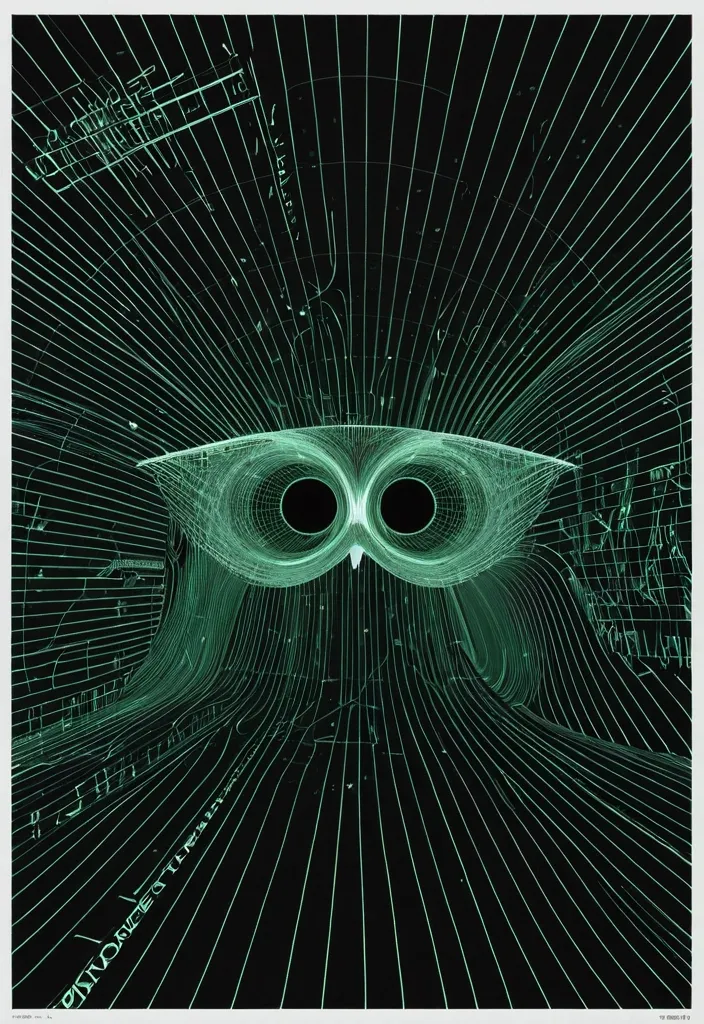

[SUBJECT]: Owl face , eyes look over the upper edges of translucent fluorescent green eyeglasses that sit low across the bridge of his nose [BACKGROUND]: night-sky [RASTER LINES]: gray [DIRECTION]: vortex Design an experimental poster using a continuous high-density raster line field , large-scale spatial deformation , and negative-space typography. Cover the entire composition with fine parallel lines. Keep every line clean , continuous , smooth , uniform in thickness , and consistently spaced. The lines should form one coherent field with no breaks , intersections , sudden bends , or random short fragments. Place Owl face as the main visual , occupying roughly 70–80% of the composition. Do not simply place the subject on top of the lines. Instead , make it feel like a hidden 3D form pushing through the raster field. Use only 2–4 large , controlled deformation zones rather than many small ripples. Let the lines smoothly compress , expand , bend , and flow around the subject , then gradually return to the original parallel field away from it. The subject should become visible mainly through deformation and negative space. Keep only minimal real details where needed for recognition. Create 2–3 small information areas inside quieter negative spaces. Use minimal modern sans-serif typography with strong hierarchy and generous spacing. Keep the text much smaller than the main visual and avoid placing it over dense line areas. Style: Op Art , generative graphic design , experimental typography , contemporary editorial poster , refined and minimal. Prioritize line quality above everything else: extremely fine , sharp , elegant , uninterrupted curves with smooth deformation and precise spacing. Avoid broken lines , warped or jagged curves , intersections , chaotic ripples , excessive realism , generic sci-fi UI , cyberpunk effects , excessive text , logos , numbering , starbursts , and sparkles. ,