Search Results for product
Explore AI generated designs, images, art and prompts by top community artists and designers.

Make a cover for the freelancer website Kwork. I create product card designs for people; the marketplaces are Wildberries and Ozon. The cover size should be at least 660 x 440 px. Make it in the style of regular text with a background , but include some designer elements either in the background or in the text itself , at your discretion. The text must contain these words: Designer Viktor , Infographics , Quality and Original , Wildberries and Ozon. ,

A beautiful European woman with long , flowing hair holds a bottle of hair product prominently in the foreground. She has fair skin and striking features , exuding elegance and confidence. The setting is a modern and stylish salon , with chic furniture and sophisticated decor elements that elevate the atmosphere. The product label and the woman’s chic red outfit stand out , creating an inviting and professional image. The text on the image remains intact , emphasizing the benefits of the product for various types of damaged , bleached , or dull hair. The overall composition should be vibrant and sharp , highlighting the quality and appeal of the hair product she’s promoting , while maintaining balance and visual appeal. ,

A beautiful European woman with long , flowing hair holds a bottle of hair product prominently in the foreground. She has fair skin and striking features , exuding elegance and confidence. The setting is a modern and stylish salon , with chic furniture and sophisticated decor elements that elevate the atmosphere. The product label and the woman’s chic red outfit stand out , creating an inviting and professional image. The text on the image remains intact , emphasizing the benefits of the product for various types of damaged , bleached , or dull hair. The overall composition should be vibrant and sharp , highlighting the quality and appeal of the hair product she’s promoting , while maintaining balance and visual appeal. ,
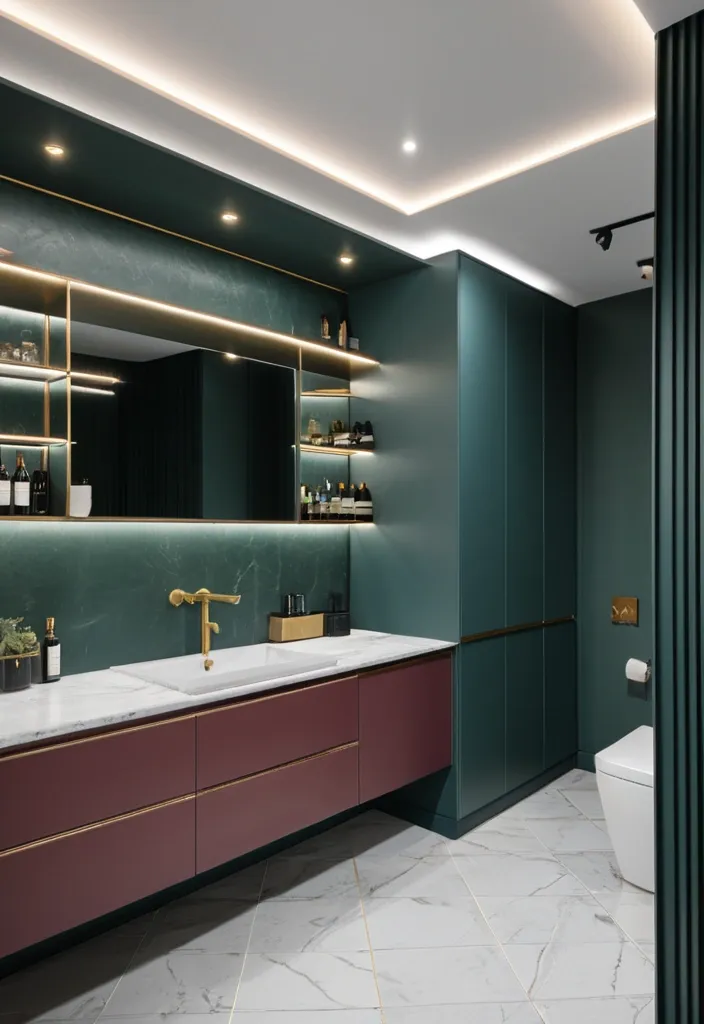
Modern Luxe style , Residential interior design , Deep jewel tones , Light floors , White matte ceiling , Floor-to-ceiling storage , No beige/grey/white wall backgrounds , Warm lighting (2700-3000K) , Rich textures (velvet , gloss , metal) , High detail , 8K , Photorealistic , Architectural Digest style L-shaped kitchen unit: Glossy Wine-Burgundy lower cabinets , Matte muted Terracotta upper cabinets extending to ceiling. Dark quartz countertop. Gold mosaic backsplash reflecting light. No kitchen island. Compact dining table with Indigo velvet chairs , brass legs. Visual separation: Low open shelving unit (matte black) between zones. Living room: Dusty Rose walls , Emerald Green accent wall behind a Dark Blue velvet sofa. Light "Statuario" floor throughout. Integrated floor-to-ceiling storage with LED lighting. Warm brass pendant lights over dining , track lighting in living. Photorealistic , detailed materials. Serene master bedroom: Matte Indigo Blue accent wall behind bed with luxurious velvet headboard. Soft Lavender on other walls. Floor-to-ceiling matte white gloss wardrobe. High-pile Dusty Rose area rug on light flooring. Brass wall sconces with linen shades (2700K). Matte textures , dimmable lighting , no harsh contrasts. Realistic fabric textures (velvet , linen). Productive home office: Walls in soft Sage Green with deep Emerald Green accent behind desk. Floor-to-ceiling storage cabinets in matte Wormwood (Полынь) or Sage Green. Floating dark oak desk. Leather Wine-Burgundy chair. Black metal open shelves. Task lighting: 4000K adjustable desk lamp + warm ambient spots. Light floors , white ceiling. Minimal decor , focused atmosphere. Luxury bathroom: Matte Dark Blue walls with gold mosaic niche. Floating white gloss vanity. Full-wall mirror with integrated LED lighting. Walk-in shower with rainfall head. Light anti-slip tiles. Brass fixtures. Floor-to-ceiling storage cabinet above toilet. Steam , clean lines , high-end materials. Photorealistic water reflections. Functional utility room: Serene Smoky Moss (Дымный мох) matte floor-to-ceiling cabinets. Soft Grey-Blue walls. Durable light flooring. Built-in washing machine/dryer , pull-out ironing board , labeled storage bins. Bright 4000K LED panel lighting. Bronze handles. Neat , organized , no clutter. Calm nursery for baby: Soft Cloudy Blue walls with muted Mint Green accent wall. Matte Ecru floor-to-ceiling cabinets (rounded corners). Natural wood crib. Cork flooring. Playful "lawn-shaped" rug. Cloud-shaped ceiling light + 2200K nightlight. Storage: Lower toy drawers , upper clothing shelves. Blackout curtains. Safety features: socket covers , soft edges. Gentle , airy , growth-friendly space. - AVOID: Beige , grey , or white wall backgrounds. - MUST: Deep colored accent walls (emerald , burgundy , indigo) dominate. - Lighting: Warm (2700-3000K) everywhere except task zones (4000K). Use dimmers , LEDs , brass fixtures. - Storage: Seamless floor-to-ceiling cabinets dominate each room. - Textures: Contrast matte (walls , velvet) + gloss (kitchen , vanity) + metal (brass , bronze). - Floor: Uniform light large-format tile (except nursery: cork). - Mood: Luxurious but livable; dramatic colors balanced by light floors/ceiling. --no beige , grey walls , white walls , cluttered space , cold lighting , separate rooms , rugs in kitchen ,

Productive home office: Walls in soft Sage Green with deep Emerald Green accent behind desk. Floor-to-ceiling storage cabinets in matte Wormwood (Полынь) or Sage Green. Floating dark oak desk. Leather Wine-Burgundy chair. Black metal open shelves. Task lighting: 4000K adjustable desk lamp + warm ambient spots. Light floors , white ceiling. Minimal decor , focused atmosphere. ,

Vertical banner for large-format printing , dimensions 1 meter tall x 0.50 meters wide , for a store selling keto products. At the top , a minimalist circular logo in green and gold. Below , a very large and centered main text in one single line: PRODUCTOS KETO. Below that , a list of products in ALL CAPS , clear and readable typography: SORRENTINOS , TALLARINES , TAPAS DE EMPANADAS Y PASCUALINA , BUDINES , TORTAS DULCES INDIVIDUALES , ALFAJORES , PANES KETO. Include realistic , appetizing photos of the mentioned products arranged neatly around the text , with warm lighting. Background in light tones (white or soft beige) with fresh green accents. Modern , clean style in high resolution , suitable for printing. ,


generate a character in a minimalist modern style that reflects the product feed automation service. Text that reflects the USP: Even perfectly cleaned data won't be useful if it doesn't match the store's structure. Most services require manual work at this stage. We've solved this problem! First , we analyze your current catalog: you upload a sample of your data , and we understand how your fields are named and what format your characteristics are in. We then automatically convert the supplier data to your format , eliminating the need for manual mapping and human error. ,



Make a prototype of a block for the data processing service website page (the service uses AI when necessary) , taking into account the following requirements: Hero block (Hero section) The purpose of the block is to immediately attract attention and convey the key SEO USP: NotPIM — conversion of product feeds in any direction for online stores. Texts: Title (H1): "Conversion of product feeds in any direction — quickly , accurately , and without unnecessary work" Subtitle: "From the chaos of price lists and data from suppliers to a ready-made catalog in the desired format. Automation without programmers." CTA button: "Try it for free" Visual: illustration/animation "disparate feeds → clean catalog". ,
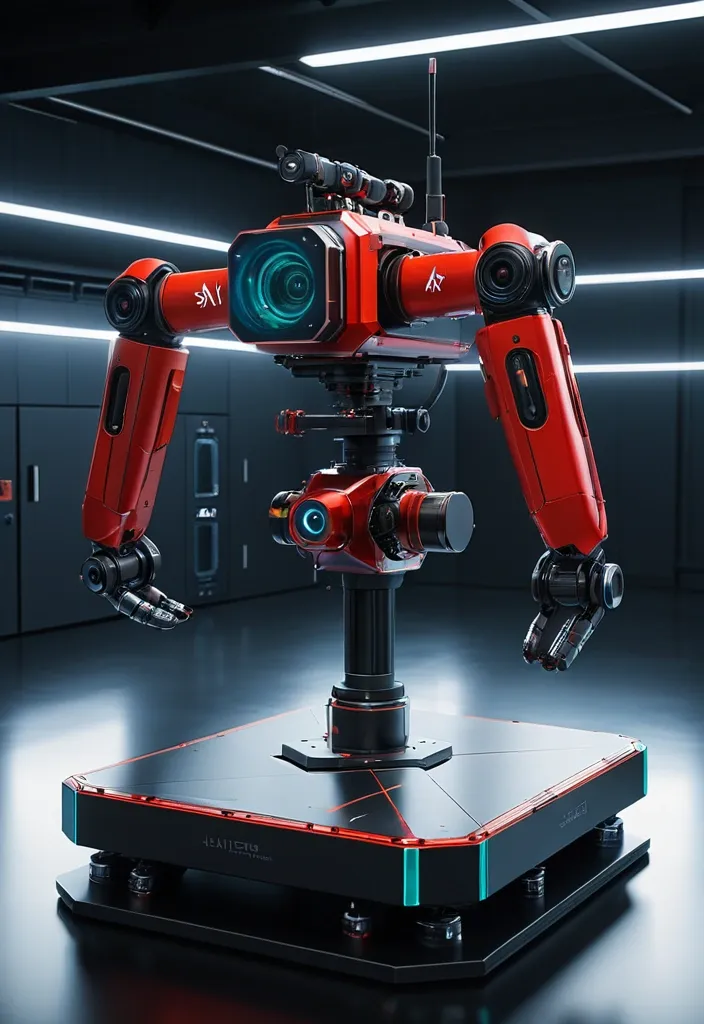
A high-tech industrial robotic media production station with multiple articulated arms mounted on a stable mechanical base platform , inspired by advanced industrial manipulators and spider-drone engineering. No humanoid legs or head — instead , a central cylindrical module houses an array of optical sensors , precision lenses , LED light indicators , and integrated holographic projectors. The robot is designed for creative media work , not combat — smooth aerodynamic contours with reduced sharp edges , and numerous embedded holographic and light-based UI elements showing AI interfaces , media timelines , live video feeds , and floating icons of Instagram and YouTube. Each arm has integrated tools: a built-in 8K camera module , a ring light embedded in the arm structure , directional microphones , a fold-out tablet screen , and holographic control panels — all seamlessly part of the mechanical design , not handheld. Premium materials: glossy aviation-grade bright red paint (#FF1C1C) with asphalt-dark gray (#2B2B2B) structural panels , anodized metal joints , carbon fiber inserts , and fine blue-turquoise seam lighting. Ultra-detailed photorealistic textures with bolts , seams , micro-scratches , and realistic reflections. Cinematic lighting with clean white highlights , subtle shadows , and product showcase style — isolated on a transparent background with a soft gradient light spot beneath , as if presented at an Apple/DJI launch. High-poly model , no cartoonish simplification , no text or logos. ,

((iridescent opalescent reproduction of the name " KAY " )) , SPELT as per previous prompt , { K A Y } , NO ERRORS!!! , K A Y , candyland , warm tones , bioluminescent : by michal karcz , daniel merriam , ornate , dynamic , particulate , intricate , elegant , highly detailed , neon butterflies , neon love hearts , centered , artstation , smooth , sharp focus , octane render , poster art , wall art , KAY ,
Physical Characteristics: Size & Weight: Between 40 to 60 feet in length , weighing 50 to 75 tons. Coloration: Males: Sleek black base with dark gray tiger stripes accented by subtle red bioluminescent highlights along the stripes , glowing faintly in deep ocean darkness. Body Structure: Hydrodynamic , muscular body combining the streamlined agility of the Shortfin Mako and Black Marlin with the robust power of Predator X and Megalodon. Rigid pectoral fins adapted from Black Marlin , capable of tilting back to reduce drag at high speeds. The tailend is a powerful fluke for propulsion , inspired by Mosasaurus Hoffmannii and Orca anatomy. Thick , overlapping bony scales similar to Arapaima , providing a durable armor that flexes with movement. Limbs: Powerful large flippers adapted for scooting or sliding on land , coated with mucus inspired by the Atlantic hagfish for moisture retention and defense. Capable of limited terrestrial movement , allowing brief excursions out of water. Head & Jaw: Massive jaws with over 40 , 000 PSI bite force , blending Predator X’s mighty jaw strength with the long canine teeth and powerful bite of the Leopard Seal. Flexible skull allowing swallowing of large prey whole. Respiration: Dual respiratory system with both functional lungs and gills , enabling survival from surface to abyssal depths (500 to 9 , 800 feet). Bioluminescence: Red bioluminescent photophores patterned in tiger stripes , used for communication , intimidation , mating displays , and luring prey in the dark ocean depths. Abilities & Traits: Speed & Agility: Capable of bursts up to 82 mph , rivaling the fastest sea creatures like the Black Marlin. Agile hunter using stealth and passive listening , mimicking Transient Killer Whale hunting strategies. Social Structure: Small family groups of three (one male , two females) designed for efficient reproduction and hunting. Males are more streamlined and shorter , optimized for speed and power; females are larger , robust , and agile for endurance and nurturing. Regeneration: Remarkable limb regeneration inspired by axolotl and Crown-of-Thorns starfish , able to regrow lost fins , limbs , and even parts of internal organs. Defense: Venomous spines derived from Crown-of-Thorns starfish line its dorsal ridge , delivering painful venomous wounds to attackers. Mucus coating for defense and moisture retention , also making it slippery and difficult to grasp. Healing: A blubber-like layer similar to dolphins provides insulation , buoyancy , and antimicrobial properties that accelerate healing of wounds. Communication: Uses low-frequency growls , barks , and hisses inspired by saltwater crocodile sounds , combined with bioluminescent signals and stealth vocalizations for hunting. Reproduction: Live births occur at extreme depths (up to 9 , 800 feet) , with offspring adapted to survive in crushing pressures and cold temperatures. ,
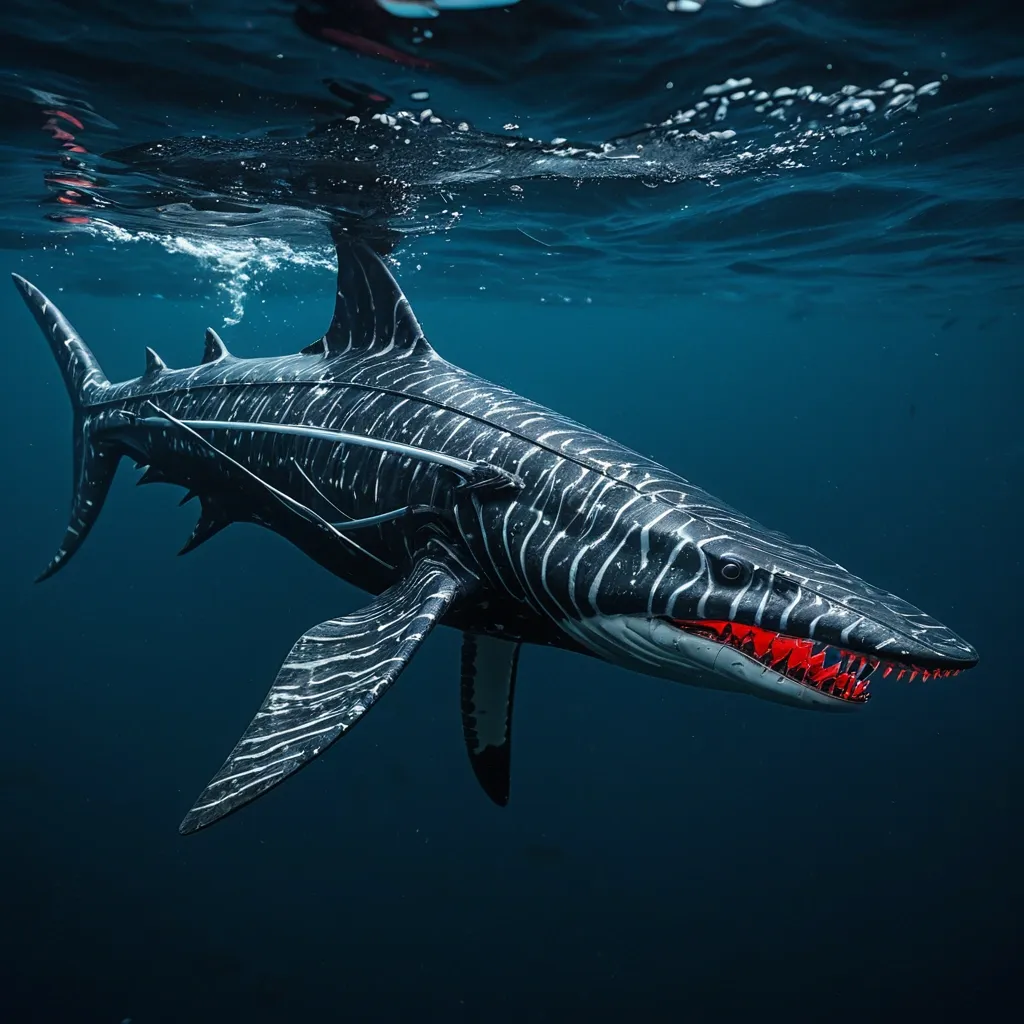
Physical Characteristics: Size & Weight: Between 40 to 60 feet in length , weighing 50 to 75 tons. Coloration: Males: Sleek black base with dark gray tiger stripes accented by subtle red bioluminescent highlights along the stripes , glowing faintly in deep ocean darkness. Body Structure: Hydrodynamic , muscular body combining the streamlined agility of the Shortfin Mako and Black Marlin with the robust power of Predator X and Megalodon. Rigid pectoral fins adapted from Black Marlin , capable of tilting back to reduce drag at high speeds. The tailend is a powerful fluke for propulsion , inspired by Mosasaurus Hoffmannii and Orca anatomy. Thick , overlapping bony scales similar to Arapaima , providing a durable armor that flexes with movement. Limbs: Powerful large flippers adapted for scooting or sliding on land , coated with mucus inspired by the Atlantic hagfish for moisture retention and defense. Capable of limited terrestrial movement , allowing brief excursions out of water. Head & Jaw: Massive jaws with over 40 , 000 PSI bite force , blending Predator X’s mighty jaw strength with the long canine teeth and powerful bite of the Leopard Seal. Flexible skull allowing swallowing of large prey whole. Respiration: Dual respiratory system with both functional lungs and gills , enabling survival from surface to abyssal depths (500 to 9 , 800 feet). Bioluminescence: Red bioluminescent photophores patterned in tiger stripes , used for communication , intimidation , mating displays , and luring prey in the dark ocean depths. Abilities & Traits: Speed & Agility: Capable of bursts up to 82 mph , rivaling the fastest sea creatures like the Black Marlin. Agile hunter using stealth and passive listening , mimicking Transient Killer Whale hunting strategies. Social Structure: Small family groups of three (one male , two females) designed for efficient reproduction and hunting. Males are more streamlined and shorter , optimized for speed and power; females are larger , robust , and agile for endurance and nurturing. Regeneration: Remarkable limb regeneration inspired by axolotl and Crown-of-Thorns starfish , able to regrow lost fins , limbs , and even parts of internal organs. Defense: Venomous spines derived from Crown-of-Thorns starfish line its dorsal ridge , delivering painful venomous wounds to attackers. Mucus coating for defense and moisture retention , also making it slippery and difficult to grasp. Healing: A blubber-like layer similar to dolphins provides insulation , buoyancy , and antimicrobial properties that accelerate healing of wounds. Communication: Uses low-frequency growls , barks , and hisses inspired by saltwater crocodile sounds , combined with bioluminescent signals and stealth vocalizations for hunting. Reproduction: Live births occur at extreme depths (up to 9 , 800 feet) , with offspring adapted to survive in crushing pressures and cold temperatures. ,
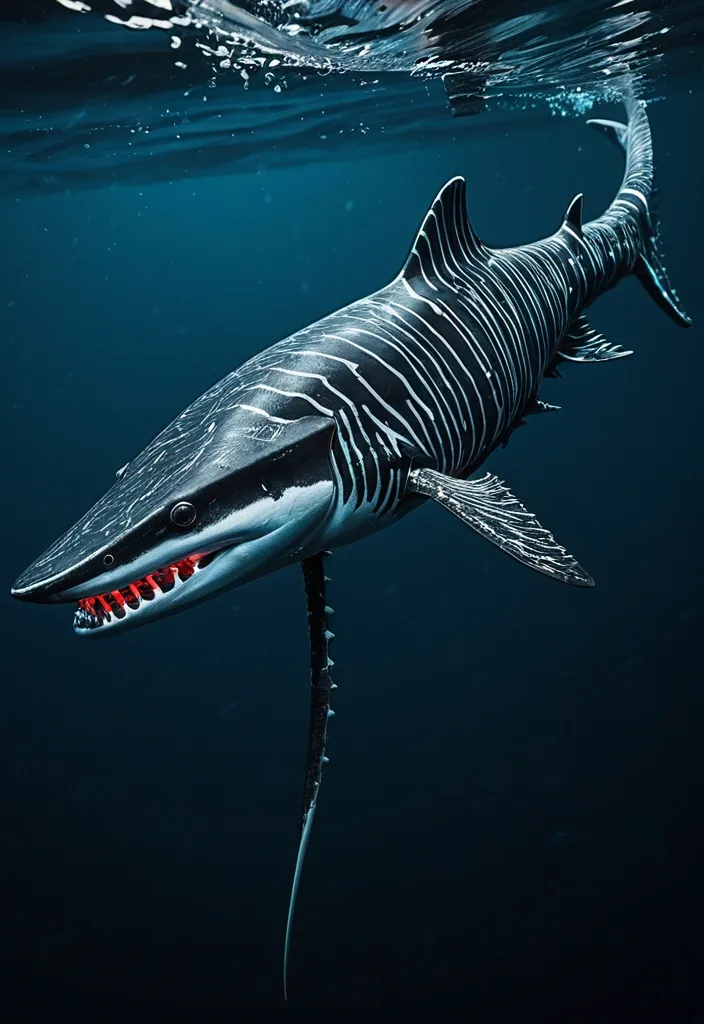
Physical Characteristics: Size & Weight: Between 40 to 60 feet in length , weighing 50 to 75 tons. Coloration: Males: Sleek black base with dark gray tiger stripes accented by subtle red bioluminescent highlights along the stripes , glowing faintly in deep ocean darkness. Body Structure: Hydrodynamic , muscular body combining the streamlined agility of the Shortfin Mako and Black Marlin with the robust power of Predator X and Megalodon. Rigid pectoral fins adapted from Black Marlin , capable of tilting back to reduce drag at high speeds. The tailend is a powerful fluke for propulsion , inspired by Mosasaurus Hoffmannii and Orca anatomy. Thick , overlapping bony scales similar to Arapaima , providing a durable armor that flexes with movement. Limbs: Powerful large flippers adapted for scooting or sliding on land , coated with mucus inspired by the Atlantic hagfish for moisture retention and defense. Capable of limited terrestrial movement , allowing brief excursions out of water. Head & Jaw: Massive jaws with over 40 , 000 PSI bite force , blending Predator X’s mighty jaw strength with the long canine teeth and powerful bite of the Leopard Seal. Flexible skull allowing swallowing of large prey whole. Respiration: Dual respiratory system with both functional lungs and gills , enabling survival from surface to abyssal depths (500 to 9 , 800 feet). Bioluminescence: Red bioluminescent photophores patterned in tiger stripes , used for communication , intimidation , mating displays , and luring prey in the dark ocean depths. Abilities & Traits: Speed & Agility: Capable of bursts up to 82 mph , rivaling the fastest sea creatures like the Black Marlin. Agile hunter using stealth and passive listening , mimicking Transient Killer Whale hunting strategies. Social Structure: Small family groups of three (one male , two females) designed for efficient reproduction and hunting. Males are more streamlined and shorter , optimized for speed and power; females are larger , robust , and agile for endurance and nurturing. Regeneration: Remarkable limb regeneration inspired by axolotl and Crown-of-Thorns starfish , able to regrow lost fins , limbs , and even parts of internal organs. Defense: Venomous spines derived from Crown-of-Thorns starfish line its dorsal ridge , delivering painful venomous wounds to attackers. Mucus coating for defense and moisture retention , also making it slippery and difficult to grasp. Healing: A blubber-like layer similar to dolphins provides insulation , buoyancy , and antimicrobial properties that accelerate healing of wounds. Communication: Uses low-frequency growls , barks , and hisses inspired by saltwater crocodile sounds , combined with bioluminescent signals and stealth vocalizations for hunting. Reproduction: Live births occur at extreme depths (up to 9 , 800 feet) , with offspring adapted to survive in crushing pressures and cold temperatures. ,
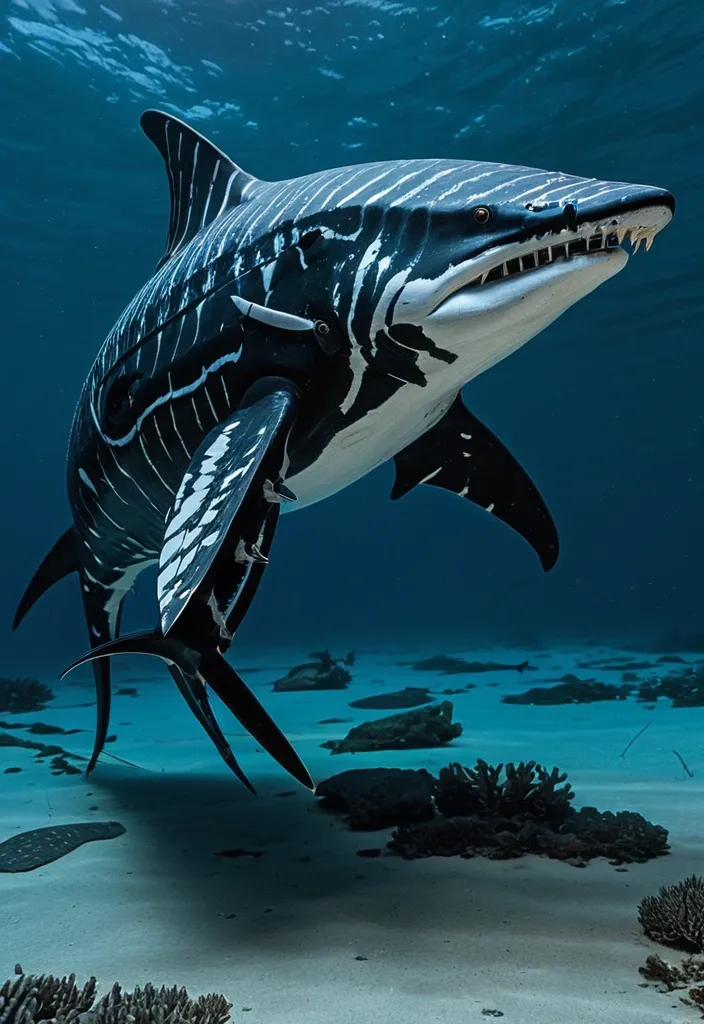
Physical Characteristics: Size & Weight: Between 40 to 60 feet in length , weighing 50 to 75 tons. Coloration: Males: Sleek black base with dark gray tiger stripes accented by subtle red bioluminescent highlights along the stripes , glowing faintly in deep ocean darkness. Body Structure: Hydrodynamic , muscular body combining the streamlined agility of the Shortfin Mako and Black Marlin with the robust power of Predator X and Megalodon. Rigid pectoral fins adapted from Black Marlin , capable of tilting back to reduce drag at high speeds. The tailend is a powerful fluke for propulsion , inspired by Mosasaurus Hoffmannii and Orca anatomy. Thick , overlapping bony scales similar to Arapaima , providing a durable armor that flexes with movement. Limbs: Powerful large flippers adapted for scooting or sliding on land , coated with mucus inspired by the Atlantic hagfish for moisture retention and defense. Capable of limited terrestrial movement , allowing brief excursions out of water. Head & Jaw: Massive jaws with over 40 , 000 PSI bite force , blending Predator X’s mighty jaw strength with the long canine teeth and powerful bite of the Leopard Seal. Flexible skull allowing swallowing of large prey whole. Respiration: Dual respiratory system with both functional lungs and gills , enabling survival from surface to abyssal depths (500 to 9 , 800 feet). Bioluminescence: Red bioluminescent photophores patterned in tiger stripes , used for communication , intimidation , mating displays , and luring prey in the dark ocean depths. Abilities & Traits: Speed & Agility: Capable of bursts up to 82 mph , rivaling the fastest sea creatures like the Black Marlin. Agile hunter using stealth and passive listening , mimicking Transient Killer Whale hunting strategies. Social Structure: Small family groups of three (one male , two females) designed for efficient reproduction and hunting. Males are more streamlined and shorter , optimized for speed and power; females are larger , robust , and agile for endurance and nurturing. Regeneration: Remarkable limb regeneration inspired by axolotl and Crown-of-Thorns starfish , able to regrow lost fins , limbs , and even parts of internal organs. Defense: Venomous spines derived from Crown-of-Thorns starfish line its dorsal ridge , delivering painful venomous wounds to attackers. Mucus coating for defense and moisture retention , also making it slippery and difficult to grasp. Healing: A blubber-like layer similar to dolphins provides insulation , buoyancy , and antimicrobial properties that accelerate healing of wounds. Communication: Uses low-frequency growls , barks , and hisses inspired by saltwater crocodile sounds , combined with bioluminescent signals and stealth vocalizations for hunting. Reproduction: Live births occur at extreme depths (up to 9 , 800 feet) , with offspring adapted to survive in crushing pressures and cold temperatures. ,
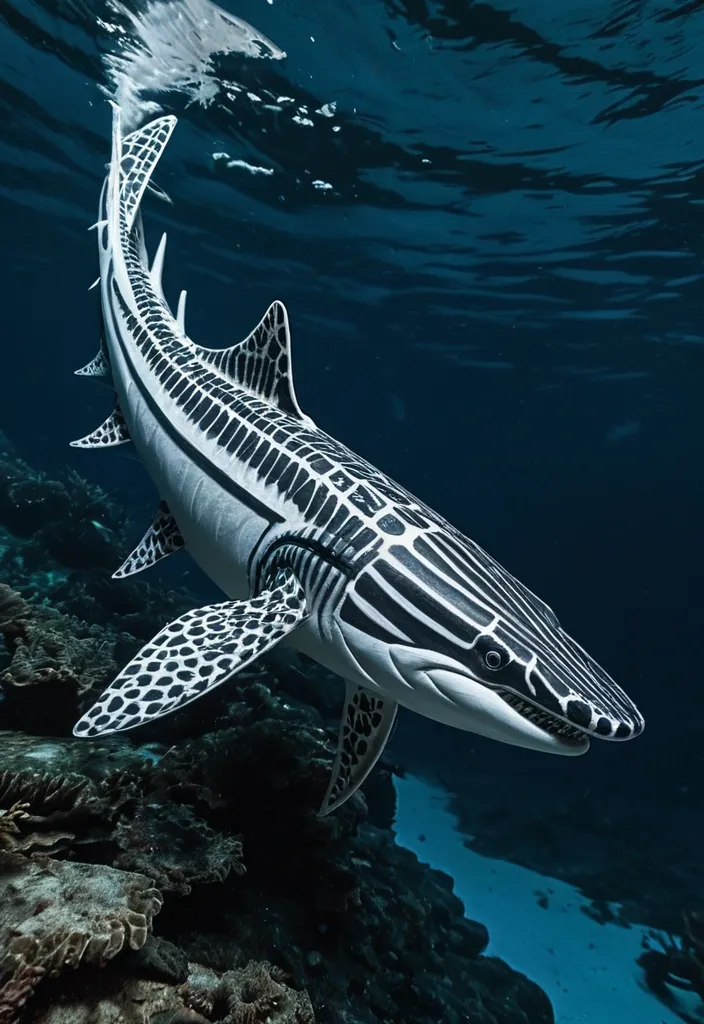
Physical Characteristics: Size & Weight: Between 40 to 60 feet in length , weighing 50 to 75 tons. Coloration: Females: Larger and more robust with black base and light gray tiger stripes , also featuring red bioluminescent patterns that pulse rhythmically. Body Structure: Hydrodynamic , muscular body combining the streamlined agility of the Shortfin Mako and Black Marlin with the robust power of Predator X and Megalodon. Rigid pectoral fins adapted from Black Marlin , capable of tilting back to reduce drag at high speeds. The tailend is a powerful fluke for propulsion , inspired by Mosasaurus Hoffmannii and Orca anatomy. Thick , overlapping bony scales similar to Arapaima , providing a durable armor that flexes with movement. Limbs: Powerful large flippers adapted for scooting or sliding on land , coated with mucus inspired by the Atlantic hagfish for moisture retention and defense. Capable of limited terrestrial movement , allowing brief excursions out of water. Head & Jaw: Massive jaws with over 40 , 000 PSI bite force , blending Predator X’s mighty jaw strength with the long canine teeth and powerful bite of the Leopard Seal. Flexible skull allowing swallowing of large prey whole. Respiration: Dual respiratory system with both functional lungs and gills , enabling survival from surface to abyssal depths (500 to 9 , 800 feet). Bioluminescence: Red bioluminescent photophores patterned in tiger stripes , used for communication , intimidation , mating displays , and luring prey in the dark ocean depths. Abilities & Traits: Speed & Agility: Capable of bursts up to 82 mph , rivaling the fastest sea creatures like the Black Marlin. Agile hunter using stealth and passive listening , mimicking Transient Killer Whale hunting strategies. Social Structure: Small family groups of three (one male , two females) designed for efficient reproduction and hunting. Males are more streamlined and shorter , optimized for speed and power; females are larger , robust , and agile for endurance and nurturing. Regeneration: Remarkable limb regeneration inspired by axolotl and Crown-of-Thorns starfish , able to regrow lost fins , limbs , and even parts of internal organs. Defense: Venomous spines derived from Crown-of-Thorns starfish line its dorsal ridge , delivering painful venomous wounds to attackers. Mucus coating for defense and moisture retention , also making it slippery and difficult to grasp. Healing: A blubber-like layer similar to dolphins provides insulation , buoyancy , and antimicrobial properties that accelerate healing of wounds. Communication: Uses low-frequency growls , barks , and hisses inspired by saltwater crocodile sounds , combined with bioluminescent signals and stealth vocalizations for hunting. Reproduction: Live births occur at extreme depths (up to 9 , 800 feet) , with offspring adapted to survive in crushing pressures and cold temperatures. ,
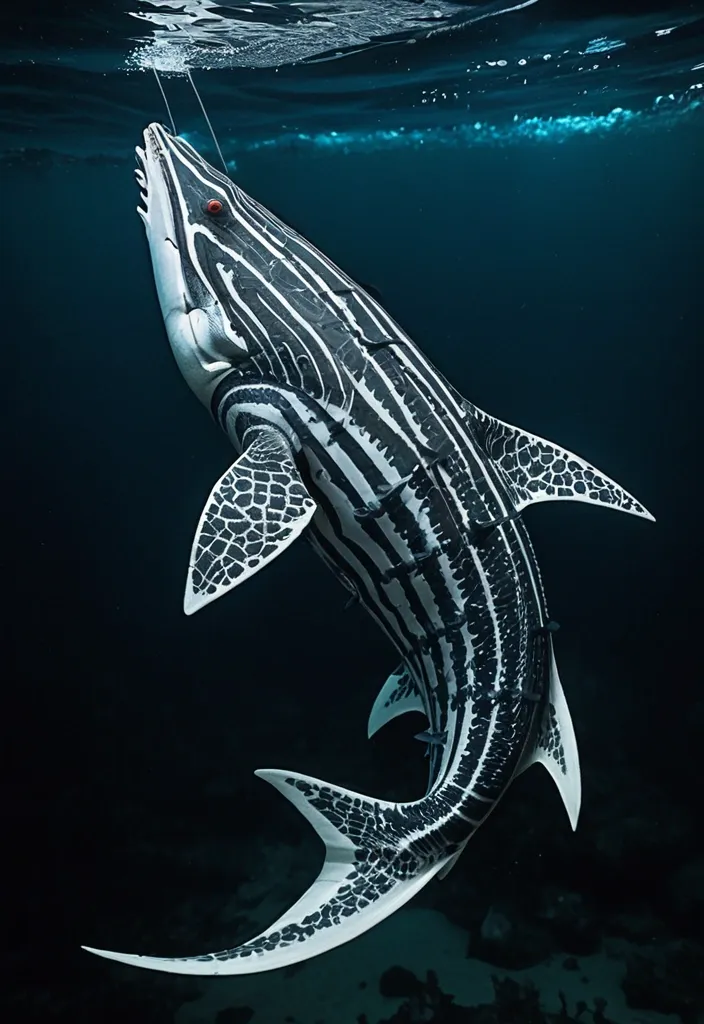
Physical Characteristics: Size & Weight: Between 40 to 60 feet in length , weighing 50 to 75 tons. Coloration: Females: Larger and more robust with black base and light gray tiger stripes , also featuring red bioluminescent patterns that pulse rhythmically. Body Structure: Hydrodynamic , muscular body combining the streamlined agility of the Shortfin Mako and Black Marlin with the robust power of Predator X and Megalodon. Rigid pectoral fins adapted from Black Marlin , capable of tilting back to reduce drag at high speeds. The tailend is a powerful fluke for propulsion , inspired by Mosasaurus Hoffmannii and Orca anatomy. Thick , overlapping bony scales similar to Arapaima , providing a durable armor that flexes with movement. Limbs: Powerful large flippers adapted for scooting or sliding on land , coated with mucus inspired by the Atlantic hagfish for moisture retention and defense. Capable of limited terrestrial movement , allowing brief excursions out of water. Head & Jaw: Massive jaws with over 40 , 000 PSI bite force , blending Predator X’s mighty jaw strength with the long canine teeth and powerful bite of the Leopard Seal. Flexible skull allowing swallowing of large prey whole. Respiration: Dual respiratory system with both functional lungs and gills , enabling survival from surface to abyssal depths (500 to 9 , 800 feet). Bioluminescence: Red bioluminescent photophores patterned in tiger stripes , used for communication , intimidation , mating displays , and luring prey in the dark ocean depths. Abilities & Traits: Speed & Agility: Capable of bursts up to 82 mph , rivaling the fastest sea creatures like the Black Marlin. Agile hunter using stealth and passive listening , mimicking Transient Killer Whale hunting strategies. Social Structure: Small family groups of three (one male , two females) designed for efficient reproduction and hunting. Males are more streamlined and shorter , optimized for speed and power; females are larger , robust , and agile for endurance and nurturing. Regeneration: Remarkable limb regeneration inspired by axolotl and Crown-of-Thorns starfish , able to regrow lost fins , limbs , and even parts of internal organs. Defense: Venomous spines derived from Crown-of-Thorns starfish line its dorsal ridge , delivering painful venomous wounds to attackers. Mucus coating for defense and moisture retention , also making it slippery and difficult to grasp. Healing: A blubber-like layer similar to dolphins provides insulation , buoyancy , and antimicrobial properties that accelerate healing of wounds. Communication: Uses low-frequency growls , barks , and hisses inspired by saltwater crocodile sounds , combined with bioluminescent signals and stealth vocalizations for hunting. Reproduction: Live births occur at extreme depths (up to 9 , 800 feet) , with offspring adapted to survive in crushing pressures and cold temperatures. ,
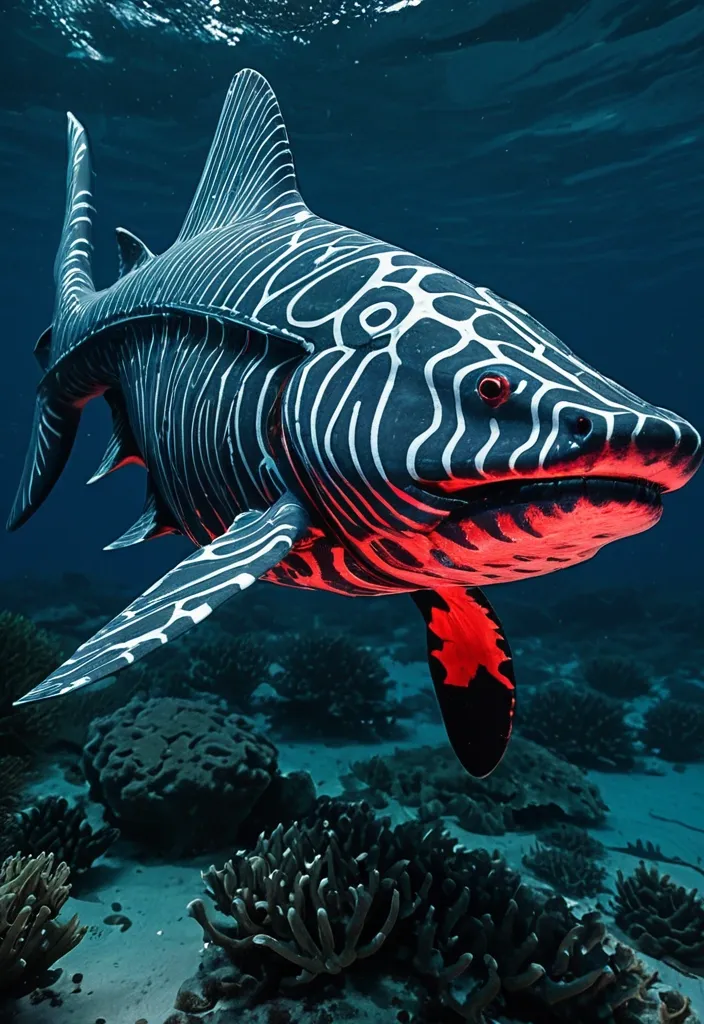
Physical Characteristics: Size & Weight: Between 40 to 60 feet in length , weighing 50 to 75 tons. Coloration: Females: Larger and more robust with black base and light gray tiger stripes , also featuring red bioluminescent patterns that pulse rhythmically. Body Structure: Hydrodynamic , muscular body combining the streamlined agility of the Shortfin Mako and Black Marlin with the robust power of Predator X and Megalodon. Rigid pectoral fins adapted from Black Marlin , capable of tilting back to reduce drag at high speeds. The tailend is a powerful fluke for propulsion , inspired by Mosasaurus Hoffmannii and Orca anatomy. Thick , overlapping bony scales similar to Arapaima , providing a durable armor that flexes with movement. Limbs: Powerful large flippers adapted for scooting or sliding on land , coated with mucus inspired by the Atlantic hagfish for moisture retention and defense. Capable of limited terrestrial movement , allowing brief excursions out of water. Head & Jaw: Massive jaws with over 40 , 000 PSI bite force , blending Predator X’s mighty jaw strength with the long canine teeth and powerful bite of the Leopard Seal. Flexible skull allowing swallowing of large prey whole. Respiration: Dual respiratory system with both functional lungs and gills , enabling survival from surface to abyssal depths (500 to 9 , 800 feet). Bioluminescence: Red bioluminescent photophores patterned in tiger stripes , used for communication , intimidation , mating displays , and luring prey in the dark ocean depths. Abilities & Traits: Speed & Agility: Capable of bursts up to 82 mph , rivaling the fastest sea creatures like the Black Marlin. Agile hunter using stealth and passive listening , mimicking Transient Killer Whale hunting strategies. Social Structure: Small family groups of three (one male , two females) designed for efficient reproduction and hunting. Males are more streamlined and shorter , optimized for speed and power; females are larger , robust , and agile for endurance and nurturing. Regeneration: Remarkable limb regeneration inspired by axolotl and Crown-of-Thorns starfish , able to regrow lost fins , limbs , and even parts of internal organs. Defense: Venomous spines derived from Crown-of-Thorns starfish line its dorsal ridge , delivering painful venomous wounds to attackers. Mucus coating for defense and moisture retention , also making it slippery and difficult to grasp. Healing: A blubber-like layer similar to dolphins provides insulation , buoyancy , and antimicrobial properties that accelerate healing of wounds. Communication: Uses low-frequency growls , barks , and hisses inspired by saltwater crocodile sounds , combined with bioluminescent signals and stealth vocalizations for hunting. Reproduction: Live births occur at extreme depths (up to 9 , 800 feet) , with offspring adapted to survive in crushing pressures and cold temperatures. ,
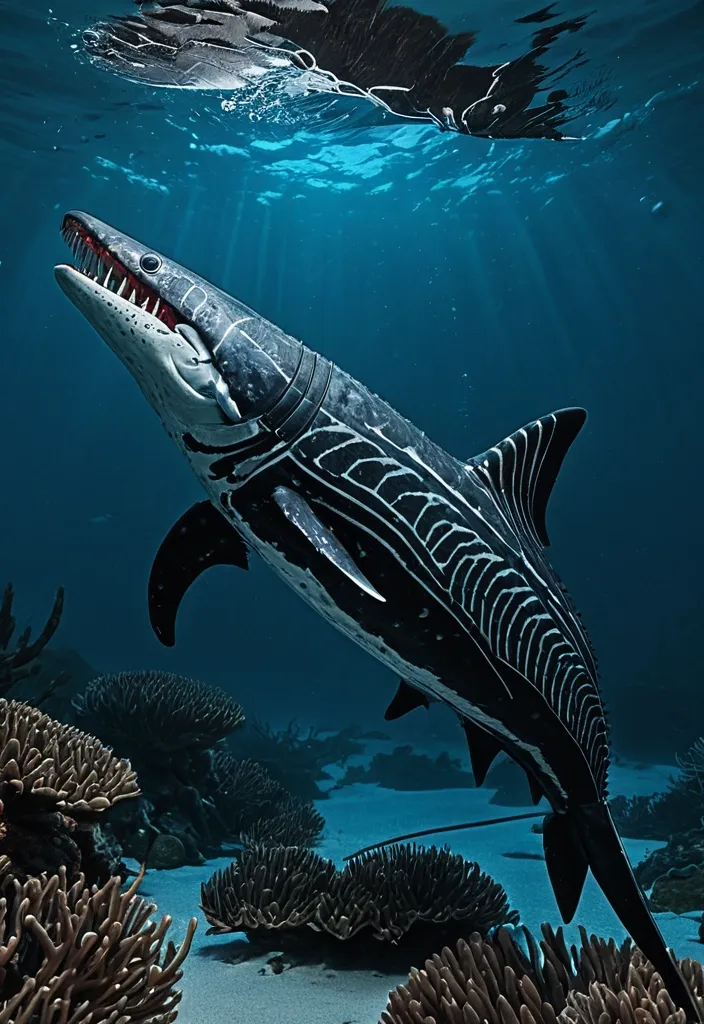
Physical Characteristics: Size & Weight: Between 40 to 60 feet in length , weighing 50 to 75 tons. Coloration: Females: Larger and more robust with black base and light gray tiger stripes , also featuring red bioluminescent patterns that pulse rhythmically. Body Structure: Hydrodynamic , muscular body combining the streamlined agility of the Shortfin Mako and Black Marlin with the robust power of Predator X and Megalodon. Rigid pectoral fins adapted from Black Marlin , capable of tilting back to reduce drag at high speeds. The tailend is a powerful fluke for propulsion , inspired by Mosasaurus Hoffmannii and Orca anatomy. Thick , overlapping bony scales similar to Arapaima , providing a durable armor that flexes with movement. Limbs: Powerful large flippers adapted for scooting or sliding on land , coated with mucus inspired by the Atlantic hagfish for moisture retention and defense. Capable of limited terrestrial movement , allowing brief excursions out of water. Head & Jaw: Massive jaws with over 40 , 000 PSI bite force , blending Predator X’s mighty jaw strength with the long canine teeth and powerful bite of the Leopard Seal. Flexible skull allowing swallowing of large prey whole. Respiration: Dual respiratory system with both functional lungs and gills , enabling survival from surface to abyssal depths (500 to 9 , 800 feet). Bioluminescence: Red bioluminescent photophores patterned in tiger stripes , used for communication , intimidation , mating displays , and luring prey in the dark ocean depths. Abilities & Traits: Speed & Agility: Capable of bursts up to 82 mph , rivaling the fastest sea creatures like the Black Marlin. Agile hunter using stealth and passive listening , mimicking Transient Killer Whale hunting strategies. Social Structure: Small family groups of three (one male , two females) designed for efficient reproduction and hunting. Males are more streamlined and shorter , optimized for speed and power; females are larger , robust , and agile for endurance and nurturing. Regeneration: Remarkable limb regeneration inspired by axolotl and Crown-of-Thorns starfish , able to regrow lost fins , limbs , and even parts of internal organs. Defense: Venomous spines derived from Crown-of-Thorns starfish line its dorsal ridge , delivering painful venomous wounds to attackers. Mucus coating for defense and moisture retention , also making it slippery and difficult to grasp. Healing: A blubber-like layer similar to dolphins provides insulation , buoyancy , and antimicrobial properties that accelerate healing of wounds. Communication: Uses low-frequency growls , barks , and hisses inspired by saltwater crocodile sounds , combined with bioluminescent signals and stealth vocalizations for hunting. Reproduction: Live births occur at extreme depths (up to 9 , 800 feet) , with offspring adapted to survive in crushing pressures and cold temperatures. ,
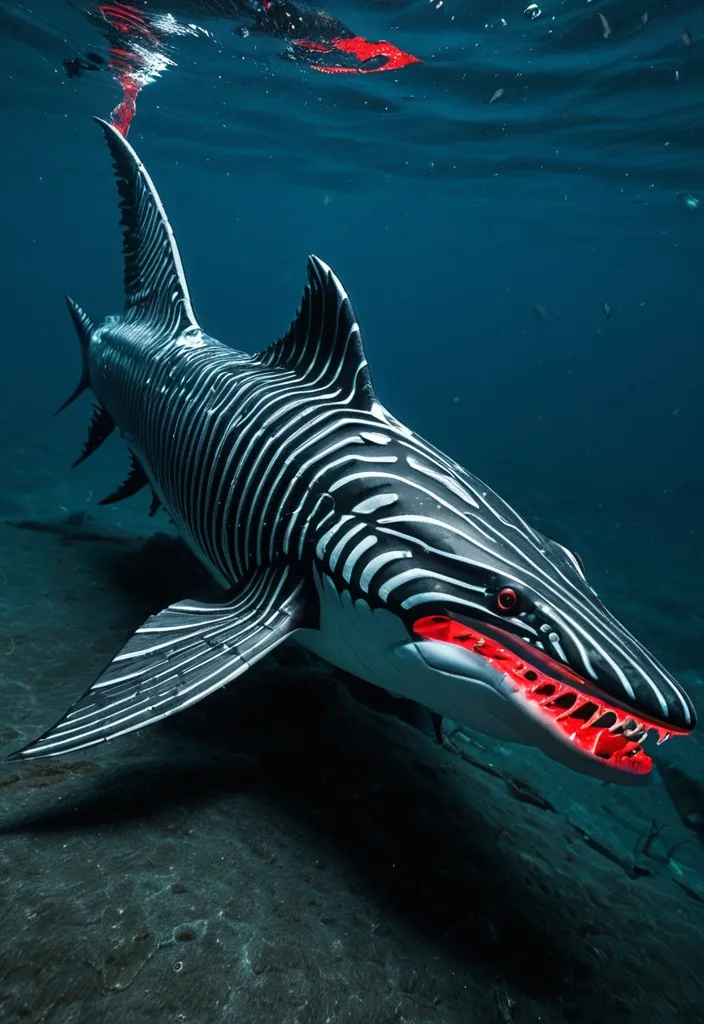
Physical Characteristics: Size & Weight: Between 40 to 60 feet in length , weighing 50 to 75 tons. Coloration: Males: Sleek black base with dark gray tiger stripes accented by subtle red bioluminescent highlights along the stripes , glowing faintly in deep ocean darkness. Body Structure: Hydrodynamic , muscular body combining the streamlined agility of the Shortfin Mako and Black Marlin with the robust power of Predator X and Megalodon. Rigid pectoral fins adapted from Black Marlin , capable of tilting back to reduce drag at high speeds. The tailend is a powerful fluke for propulsion , inspired by Mosasaurus Hoffmannii and Orca anatomy. Thick , overlapping bony scales similar to Arapaima , providing a durable armor that flexes with movement. Limbs: Powerful large flippers adapted for scooting or sliding on land , coated with mucus inspired by the Atlantic hagfish for moisture retention and defense. Capable of limited terrestrial movement , allowing brief excursions out of water. Head & Jaw: Massive jaws with over 40 , 000 PSI bite force , blending Predator X’s mighty jaw strength with the long canine teeth and powerful bite of the Leopard Seal. Flexible skull allowing swallowing of large prey whole. Respiration: Dual respiratory system with both functional lungs and gills , enabling survival from surface to abyssal depths (500 to 9 , 800 feet). Bioluminescence: Red bioluminescent photophores patterned in tiger stripes , used for communication , intimidation , mating displays , and luring prey in the dark ocean depths. Abilities & Traits: Speed & Agility: Capable of bursts up to 82 mph , rivaling the fastest sea creatures like the Black Marlin. Agile hunter using stealth and passive listening , mimicking Transient Killer Whale hunting strategies. Social Structure: Small family groups of three (one male , two females) designed for efficient reproduction and hunting. Males are more streamlined and shorter , optimized for speed and power; females are larger , robust , and agile for endurance and nurturing. Regeneration: Remarkable limb regeneration inspired by axolotl and Crown-of-Thorns starfish , able to regrow lost fins , limbs , and even parts of internal organs. Defense: Venomous spines derived from Crown-of-Thorns starfish line its dorsal ridge , delivering painful venomous wounds to attackers. Mucus coating for defense and moisture retention , also making it slippery and difficult to grasp. Healing: A blubber-like layer similar to dolphins provides insulation , buoyancy , and antimicrobial properties that accelerate healing of wounds. Communication: Uses low-frequency growls , barks , and hisses inspired by saltwater crocodile sounds , combined with bioluminescent signals and stealth vocalizations for hunting. Reproduction: Live births occur at extreme depths (up to 9 , 800 feet) , with offspring adapted to survive in crushing pressures and cold temperatures. ,
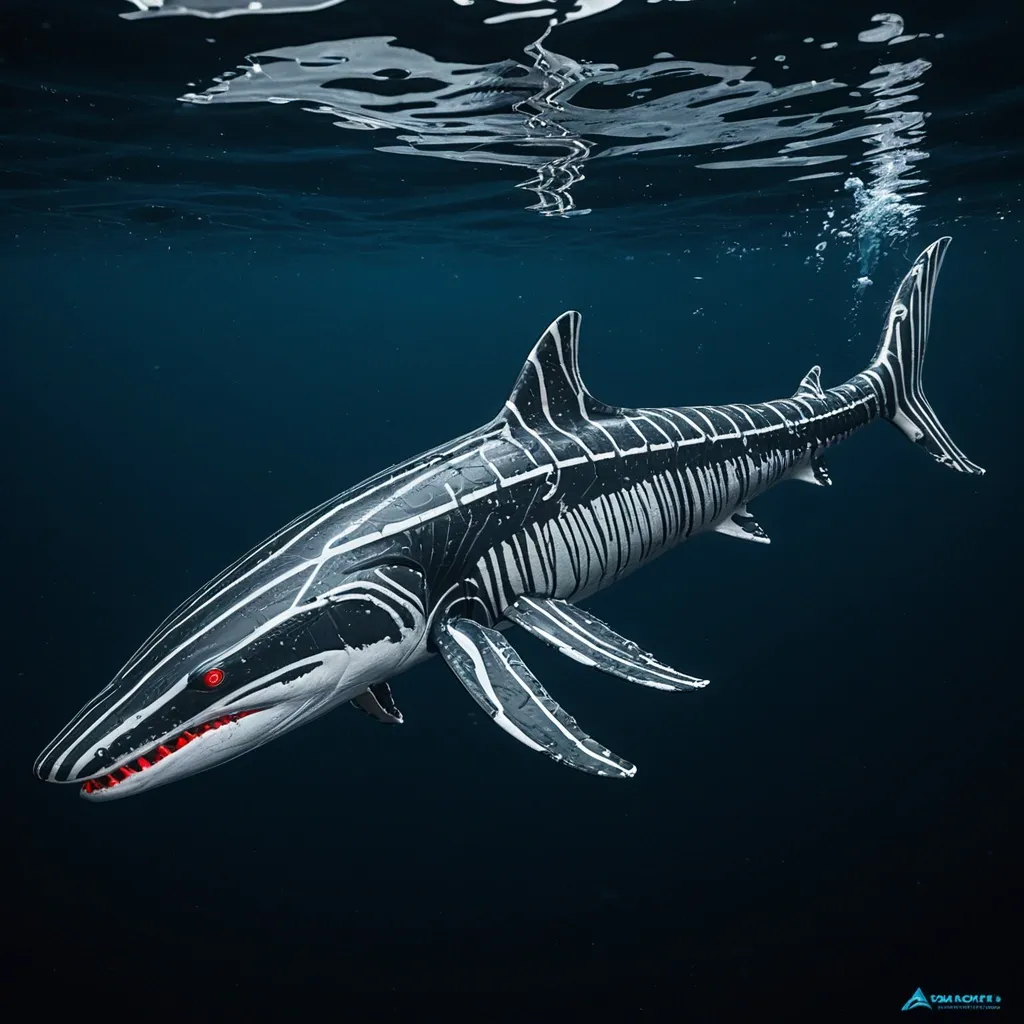
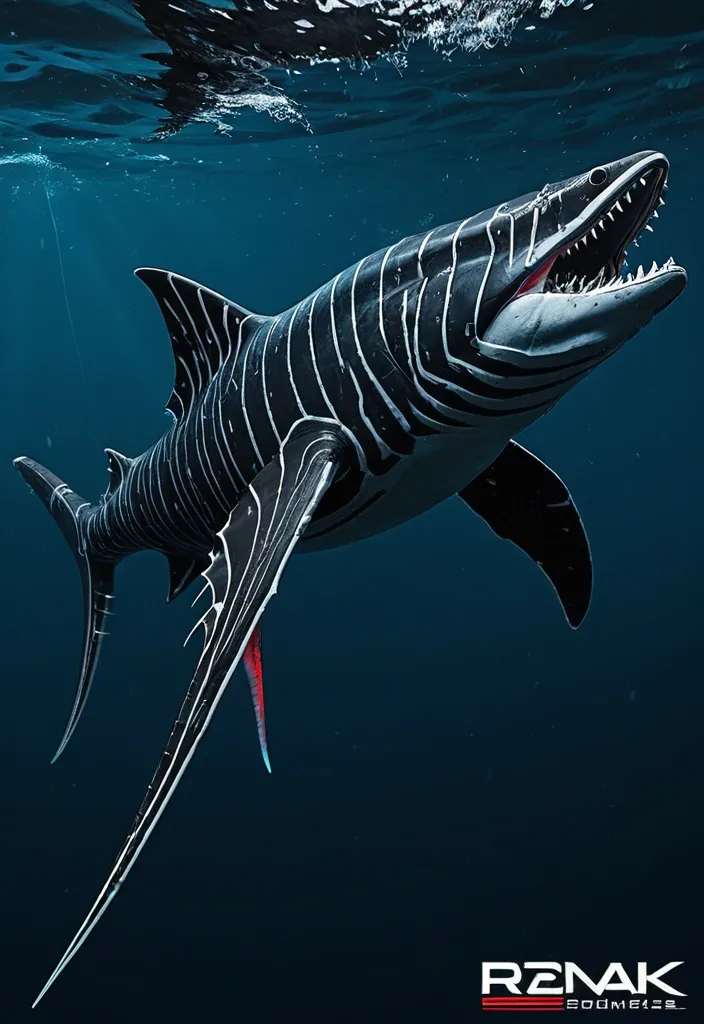
Megalosaurus Orca The Apex Hybrid of Oceanic Predation Physical Characteristics: Size & Weight: Between 40 to 60 feet in length , weighing 50 to 75 tons. Coloration: Males: Sleek black base with dark gray tiger stripes accented by subtle red bioluminescent highlights along the stripes , glowing faintly in deep ocean darkness. Females: Larger and more robust with black base and light gray tiger stripes , also featuring red bioluminescent patterns that pulse rhythmically. Body Structure: Hydrodynamic , muscular body combining the streamlined agility of the Shortfin Mako and Black Marlin with the robust power of Predator X and Megalodon. Rigid pectoral fins adapted from Black Marlin , capable of tilting back to reduce drag at high speeds. The tailend is a powerful fluke for propulsion , inspired by Mosasaurus Hoffmannii and Orca anatomy. Thick , overlapping bony scales similar to Arapaima , providing a durable armor that flexes with movement. Limbs: Powerful large flippers adapted for scooting or sliding on land , coated with mucus inspired by the Atlantic hagfish for moisture retention and defense. Capable of limited terrestrial movement , allowing brief excursions out of water. Head & Jaw: Massive jaws with over 40 , 000 PSI bite force , blending Predator X’s mighty jaw strength with the long canine teeth and powerful bite of the Leopard Seal. Flexible skull allowing swallowing of large prey whole. Respiration: Dual respiratory system with both functional lungs and gills , enabling survival from surface to abyssal depths (500 to 9 , 800 feet). Bioluminescence: Red bioluminescent photophores patterned in tiger stripes , used for communication , intimidation , mating displays , and luring prey in the dark ocean depths. Abilities & Traits: Speed & Agility: Capable of bursts up to 82 mph , rivaling the fastest sea creatures like the Black Marlin. Agile hunter using stealth and passive listening , mimicking Transient Killer Whale hunting strategies. Social Structure: Small family groups of three (one male , two females) designed for efficient reproduction and hunting. Males are more streamlined and shorter , optimized for speed and power; females are larger , robust , and agile for endurance and nurturing. Regeneration: Remarkable limb regeneration inspired by axolotl and Crown-of-Thorns starfish , able to regrow lost fins , limbs , and even parts of internal organs. Defense: Venomous spines derived from Crown-of-Thorns starfish line its dorsal ridge , delivering painful venomous wounds to attackers. Mucus coating for defense and moisture retention , also making it slippery and difficult to grasp. Healing: A blubber-like layer similar to dolphins provides insulation , buoyancy , and antimicrobial properties that accelerate healing of wounds. Communication: Uses low-frequency growls , barks , and hisses inspired by saltwater crocodile sounds , combined with bioluminescent signals and stealth vocalizations for hunting. Reproduction: Live births occur at extreme depths (up to 9 , 800 feet) , with offspring adapted to survive in crushing pressures and cold temperatures. ,
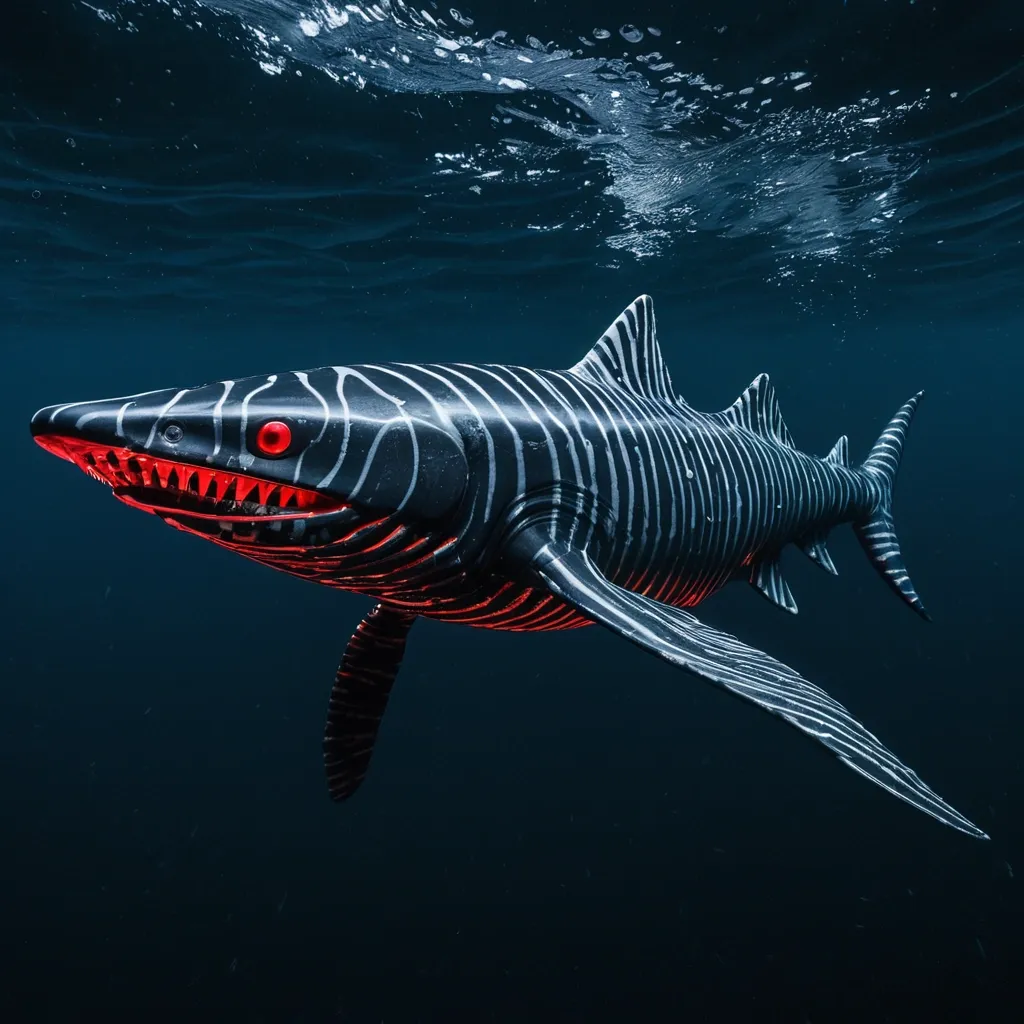
Megalosaurus Orca The Apex Hybrid of Oceanic Predation Physical Characteristics: Size & Weight: Between 40 to 60 feet in length , weighing 50 to 75 tons. Coloration: Males: Sleek black base with dark gray tiger stripes accented by subtle red bioluminescent highlights along the stripes , glowing faintly in deep ocean darkness. Females: Larger and more robust with black base and light gray tiger stripes , also featuring red bioluminescent patterns that pulse rhythmically. Body Structure: Hydrodynamic , muscular body combining the streamlined agility of the Shortfin Mako and Black Marlin with the robust power of Predator X and Megalodon. Rigid pectoral fins adapted from Black Marlin , capable of tilting back to reduce drag at high speeds. The tailend is a powerful fluke for propulsion , inspired by Mosasaurus Hoffmannii and Orca anatomy. Thick , overlapping bony scales similar to Arapaima , providing a durable armor that flexes with movement. Limbs: Powerful large flippers adapted for scooting or sliding on land , coated with mucus inspired by the Atlantic hagfish for moisture retention and defense. Capable of limited terrestrial movement , allowing brief excursions out of water. Head & Jaw: Massive jaws with over 40 , 000 PSI bite force , blending Predator X’s mighty jaw strength with the long canine teeth and powerful bite of the Leopard Seal. Flexible skull allowing swallowing of large prey whole. Respiration: Dual respiratory system with both functional lungs and gills , enabling survival from surface to abyssal depths (500 to 9 , 800 feet). Bioluminescence: Red bioluminescent photophores patterned in tiger stripes , used for communication , intimidation , mating displays , and luring prey in the dark ocean depths. Abilities & Traits: Speed & Agility: Capable of bursts up to 82 mph , rivaling the fastest sea creatures like the Black Marlin. Agile hunter using stealth and passive listening , mimicking Transient Killer Whale hunting strategies. Social Structure: Small family groups of three (one male , two females) designed for efficient reproduction and hunting. Males are more streamlined and shorter , optimized for speed and power; females are larger , robust , and agile for endurance and nurturing. Regeneration: Remarkable limb regeneration inspired by axolotl and Crown-of-Thorns starfish , able to regrow lost fins , limbs , and even parts of internal organs. Defense: Venomous spines derived from Crown-of-Thorns starfish line its dorsal ridge , delivering painful venomous wounds to attackers. Mucus coating for defense and moisture retention , also making it slippery and difficult to grasp. Healing: A blubber-like layer similar to dolphins provides insulation , buoyancy , and antimicrobial properties that accelerate healing of wounds. Communication: Uses low-frequency growls , barks , and hisses inspired by saltwater crocodile sounds , combined with bioluminescent signals and stealth vocalizations for hunting. Reproduction: Live births occur at extreme depths (up to 9 , 800 feet) , with offspring adapted to survive in crushing pressures and cold temperatures. ,
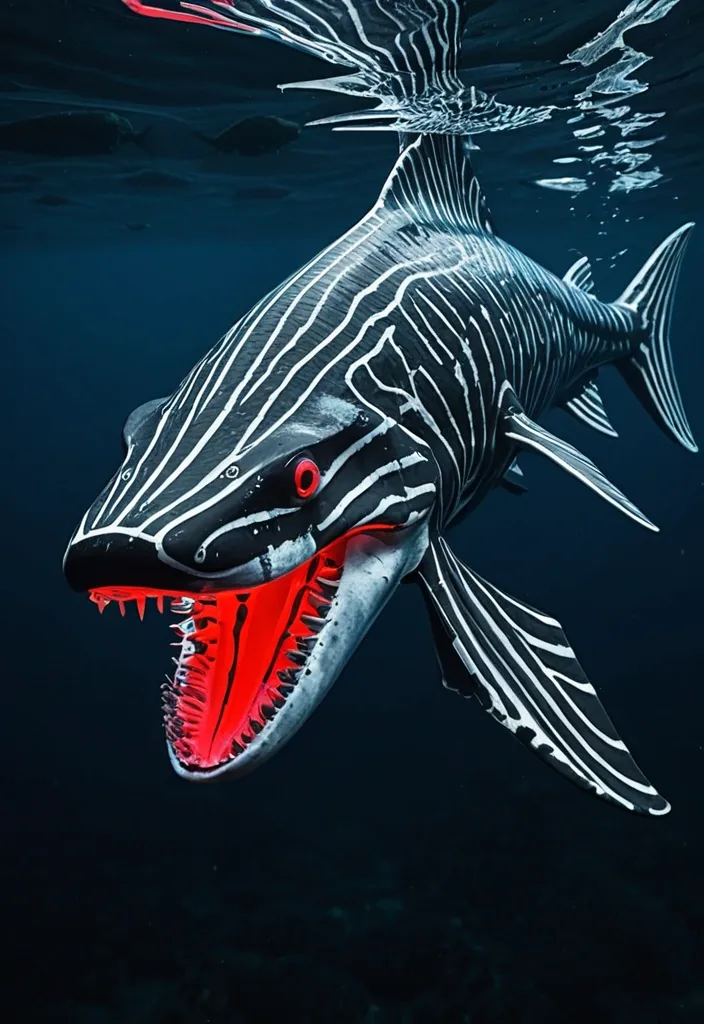
Megalosaurus Orca The Apex Hybrid of Oceanic Predation Physical Characteristics: Size & Weight: Between 40 to 60 feet in length , weighing 50 to 75 tons. Coloration: Males: Sleek black base with dark gray tiger stripes accented by subtle red bioluminescent highlights along the stripes , glowing faintly in deep ocean darkness. Females: Larger and more robust with black base and light gray tiger stripes , also featuring red bioluminescent patterns that pulse rhythmically. Body Structure: Hydrodynamic , muscular body combining the streamlined agility of the Shortfin Mako and Black Marlin with the robust power of Predator X and Megalodon. Rigid pectoral fins adapted from Black Marlin , capable of tilting back to reduce drag at high speeds. The tailend is a powerful fluke for propulsion , inspired by Mosasaurus Hoffmannii and Orca anatomy. Thick , overlapping bony scales similar to Arapaima , providing a durable armor that flexes with movement. Limbs: Powerful large flippers adapted for scooting or sliding on land , coated with mucus inspired by the Atlantic hagfish for moisture retention and defense. Capable of limited terrestrial movement , allowing brief excursions out of water. Head & Jaw: Massive jaws with over 40 , 000 PSI bite force , blending Predator X’s mighty jaw strength with the long canine teeth and powerful bite of the Leopard Seal. Flexible skull allowing swallowing of large prey whole. Respiration: Dual respiratory system with both functional lungs and gills , enabling survival from surface to abyssal depths (500 to 9 , 800 feet). Bioluminescence: Red bioluminescent photophores patterned in tiger stripes , used for communication , intimidation , mating displays , and luring prey in the dark ocean depths. Abilities & Traits: Speed & Agility: Capable of bursts up to 82 mph , rivaling the fastest sea creatures like the Black Marlin. Agile hunter using stealth and passive listening , mimicking Transient Killer Whale hunting strategies. Social Structure: Small family groups of three (one male , two females) designed for efficient reproduction and hunting. Males are more streamlined and shorter , optimized for speed and power; females are larger , robust , and agile for endurance and nurturing. Regeneration: Remarkable limb regeneration inspired by axolotl and Crown-of-Thorns starfish , able to regrow lost fins , limbs , and even parts of internal organs. Defense: Venomous spines derived from Crown-of-Thorns starfish line its dorsal ridge , delivering painful venomous wounds to attackers. Mucus coating for defense and moisture retention , also making it slippery and difficult to grasp. Healing: A blubber-like layer similar to dolphins provides insulation , buoyancy , and antimicrobial properties that accelerate healing of wounds. Communication: Uses low-frequency growls , barks , and hisses inspired by saltwater crocodile sounds , combined with bioluminescent signals and stealth vocalizations for hunting. Reproduction: Live births occur at extreme depths (up to 9 , 800 feet) , with offspring adapted to survive in crushing pressures and cold temperatures. ,
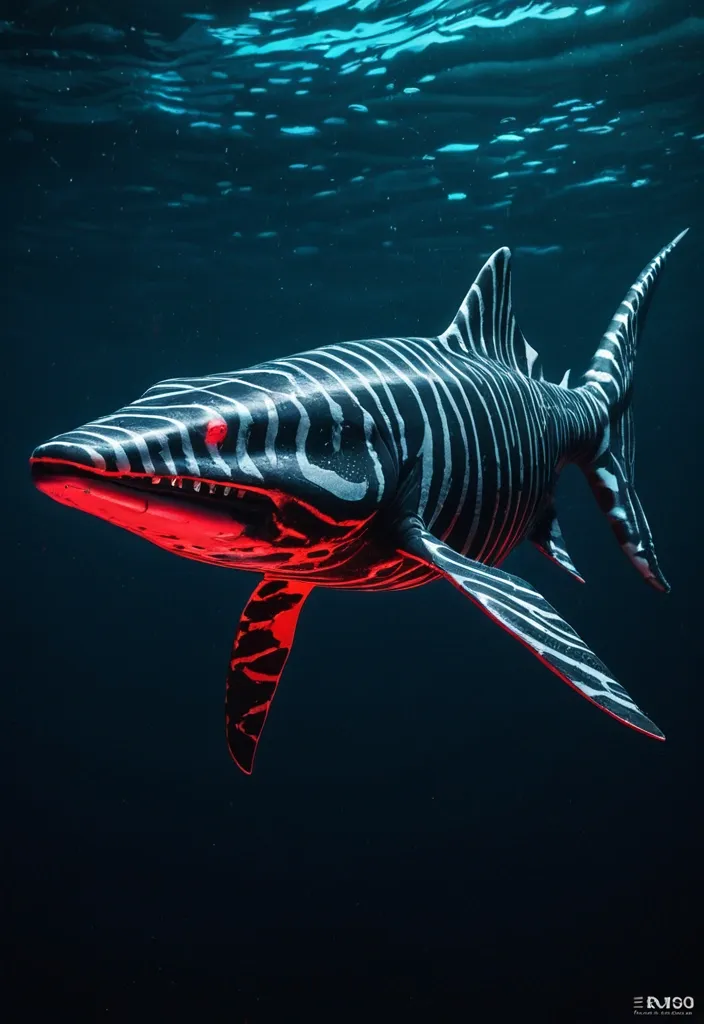
Megalosaurus Orca The Apex Hybrid of Oceanic Predation Physical Characteristics: Size & Weight: Between 40 to 60 feet in length , weighing 50 to 75 tons. Coloration: Males: Sleek black base with dark gray tiger stripes accented by subtle red bioluminescent highlights along the stripes , glowing faintly in deep ocean darkness. Females: Larger and more robust with black base and light gray tiger stripes , also featuring red bioluminescent patterns that pulse rhythmically. Body Structure: Hydrodynamic , muscular body combining the streamlined agility of the Shortfin Mako and Black Marlin with the robust power of Predator X and Megalodon. Rigid pectoral fins adapted from Black Marlin , capable of tilting back to reduce drag at high speeds. The tailend is a powerful fluke for propulsion , inspired by Mosasaurus Hoffmannii and Orca anatomy. Thick , overlapping bony scales similar to Arapaima , providing a durable armor that flexes with movement. Limbs: Powerful large flippers adapted for scooting or sliding on land , coated with mucus inspired by the Atlantic hagfish for moisture retention and defense. Capable of limited terrestrial movement , allowing brief excursions out of water. Head & Jaw: Massive jaws with over 40 , 000 PSI bite force , blending Predator X’s mighty jaw strength with the long canine teeth and powerful bite of the Leopard Seal. Flexible skull allowing swallowing of large prey whole. Respiration: Dual respiratory system with both functional lungs and gills , enabling survival from surface to abyssal depths (500 to 9 , 800 feet). Bioluminescence: Red bioluminescent photophores patterned in tiger stripes , used for communication , intimidation , mating displays , and luring prey in the dark ocean depths. Abilities & Traits: Speed & Agility: Capable of bursts up to 82 mph , rivaling the fastest sea creatures like the Black Marlin. Agile hunter using stealth and passive listening , mimicking Transient Killer Whale hunting strategies. Social Structure: Small family groups of three (one male , two females) designed for efficient reproduction and hunting. Males are more streamlined and shorter , optimized for speed and power; females are larger , robust , and agile for endurance and nurturing. Regeneration: Remarkable limb regeneration inspired by axolotl and Crown-of-Thorns starfish , able to regrow lost fins , limbs , and even parts of internal organs. Defense: Venomous spines derived from Crown-of-Thorns starfish line its dorsal ridge , delivering painful venomous wounds to attackers. Mucus coating for defense and moisture retention , also making it slippery and difficult to grasp. Healing: A blubber-like layer similar to dolphins provides insulation , buoyancy , and antimicrobial properties that accelerate healing of wounds. Communication: Uses low-frequency growls , barks , and hisses inspired by saltwater crocodile sounds , combined with bioluminescent signals and stealth vocalizations for hunting. Reproduction: Live births occur at extreme depths (up to 9 , 800 feet) , with offspring adapted to survive in crushing pressures and cold temperatures. ,
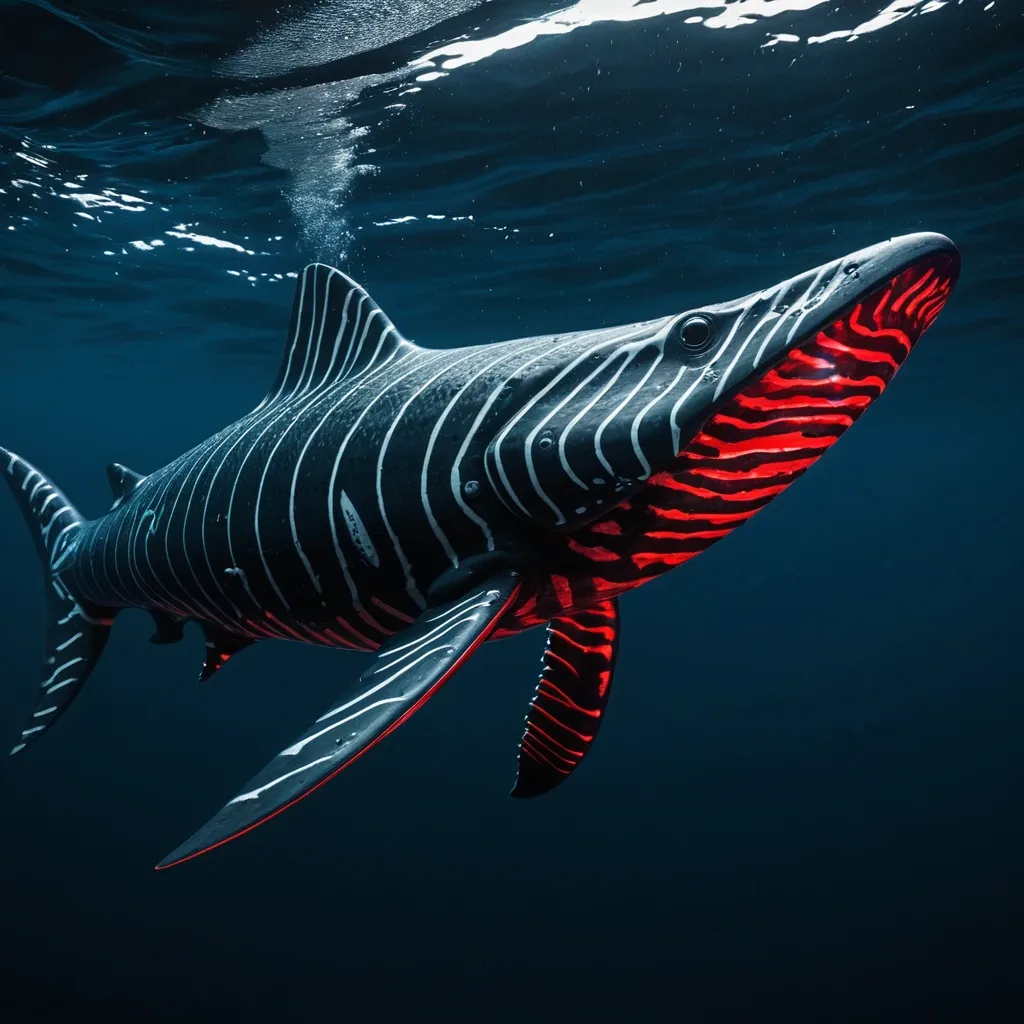
Megalosaurus Orca The Apex Hybrid of Oceanic Predation Physical Characteristics: Size & Weight: Between 40 to 60 feet in length , weighing 50 to 75 tons. Coloration: Males: Sleek black base with dark gray tiger stripes accented by subtle red bioluminescent highlights along the stripes , glowing faintly in deep ocean darkness. Females: Larger and more robust with black base and light gray tiger stripes , also featuring red bioluminescent patterns that pulse rhythmically. Body Structure: Hydrodynamic , muscular body combining the streamlined agility of the Shortfin Mako and Black Marlin with the robust power of Predator X and Megalodon. Rigid pectoral fins adapted from Black Marlin , capable of tilting back to reduce drag at high speeds. The tailend is a powerful fluke for propulsion , inspired by Mosasaurus Hoffmannii and Orca anatomy. Thick , overlapping bony scales similar to Arapaima , providing a durable armor that flexes with movement. Limbs: Powerful large flippers adapted for scooting or sliding on land , coated with mucus inspired by the Atlantic hagfish for moisture retention and defense. Capable of limited terrestrial movement , allowing brief excursions out of water. Head & Jaw: Massive jaws with over 40 , 000 PSI bite force , blending Predator X’s mighty jaw strength with the long canine teeth and powerful bite of the Leopard Seal. Flexible skull allowing swallowing of large prey whole. Respiration: Dual respiratory system with both functional lungs and gills , enabling survival from surface to abyssal depths (500 to 9 , 800 feet). Bioluminescence: Red bioluminescent photophores patterned in tiger stripes , used for communication , intimidation , mating displays , and luring prey in the dark ocean depths. Abilities & Traits: Speed & Agility: Capable of bursts up to 82 mph , rivaling the fastest sea creatures like the Black Marlin. Agile hunter using stealth and passive listening , mimicking Transient Killer Whale hunting strategies. Social Structure: Small family groups of three (one male , two females) designed for efficient reproduction and hunting. Males are more streamlined and shorter , optimized for speed and power; females are larger , robust , and agile for endurance and nurturing. Regeneration: Remarkable limb regeneration inspired by axolotl and Crown-of-Thorns starfish , able to regrow lost fins , limbs , and even parts of internal organs. Defense: Venomous spines derived from Crown-of-Thorns starfish line its dorsal ridge , delivering painful venomous wounds to attackers. Mucus coating for defense and moisture retention , also making it slippery and difficult to grasp. Healing: A blubber-like layer similar to dolphins provides insulation , buoyancy , and antimicrobial properties that accelerate healing of wounds. Communication: Uses low-frequency growls , barks , and hisses inspired by saltwater crocodile sounds , combined with bioluminescent signals and stealth vocalizations for hunting. Reproduction: Live births occur at extreme depths (up to 9 , 800 feet) , with offspring adapted to survive in crushing pressures and cold temperatures. ,
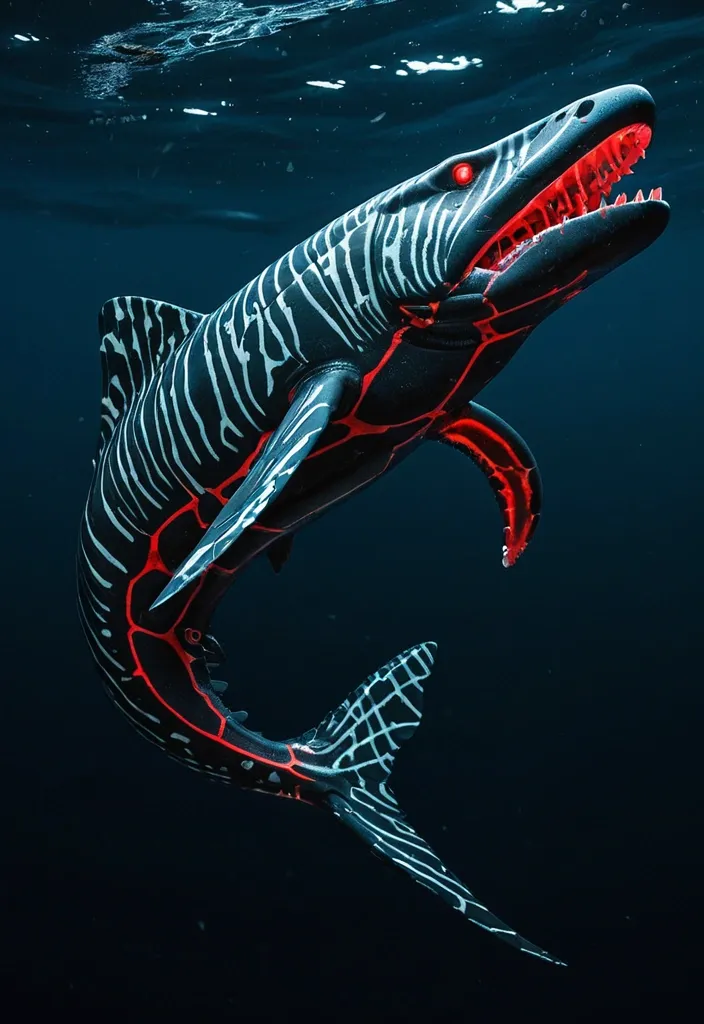
Megalosaurus Orca The Apex Hybrid of Oceanic Predation Physical Characteristics: Size & Weight: Between 40 to 60 feet in length , weighing 50 to 75 tons. Coloration: Males: Sleek black base with dark gray tiger stripes accented by subtle red bioluminescent highlights along the stripes , glowing faintly in deep ocean darkness. Females: Larger and more robust with black base and light gray tiger stripes , also featuring red bioluminescent patterns that pulse rhythmically. Body Structure: Hydrodynamic , muscular body combining the streamlined agility of the Shortfin Mako and Black Marlin with the robust power of Predator X and Megalodon. Rigid pectoral fins adapted from Black Marlin , capable of tilting back to reduce drag at high speeds. The tailend is a powerful fluke for propulsion , inspired by Mosasaurus Hoffmannii and Orca anatomy. Thick , overlapping bony scales similar to Arapaima , providing a durable armor that flexes with movement. Limbs: Powerful large flippers adapted for scooting or sliding on land , coated with mucus inspired by the Atlantic hagfish for moisture retention and defense. Capable of limited terrestrial movement , allowing brief excursions out of water. Head & Jaw: Massive jaws with over 40 , 000 PSI bite force , blending Predator X’s mighty jaw strength with the long canine teeth and powerful bite of the Leopard Seal. Flexible skull allowing swallowing of large prey whole. Respiration: Dual respiratory system with both functional lungs and gills , enabling survival from surface to abyssal depths (500 to 9 , 800 feet). Bioluminescence: Red bioluminescent photophores patterned in tiger stripes , used for communication , intimidation , mating displays , and luring prey in the dark ocean depths. Abilities & Traits: Speed & Agility: Capable of bursts up to 82 mph , rivaling the fastest sea creatures like the Black Marlin. Agile hunter using stealth and passive listening , mimicking Transient Killer Whale hunting strategies. Social Structure: Small family groups of three (one male , two females) designed for efficient reproduction and hunting. Males are more streamlined and shorter , optimized for speed and power; females are larger , robust , and agile for endurance and nurturing. Regeneration: Remarkable limb regeneration inspired by axolotl and Crown-of-Thorns starfish , able to regrow lost fins , limbs , and even parts of internal organs. Defense: Venomous spines derived from Crown-of-Thorns starfish line its dorsal ridge , delivering painful venomous wounds to attackers. Mucus coating for defense and moisture retention , also making it slippery and difficult to grasp. Healing: A blubber-like layer similar to dolphins provides insulation , buoyancy , and antimicrobial properties that accelerate healing of wounds. Communication: Uses low-frequency growls , barks , and hisses inspired by saltwater crocodile sounds , combined with bioluminescent signals and stealth vocalizations for hunting. Reproduction: Live births occur at extreme depths (up to 9 , 800 feet) , with offspring adapted to survive in crushing pressures and cold temperatures. ,
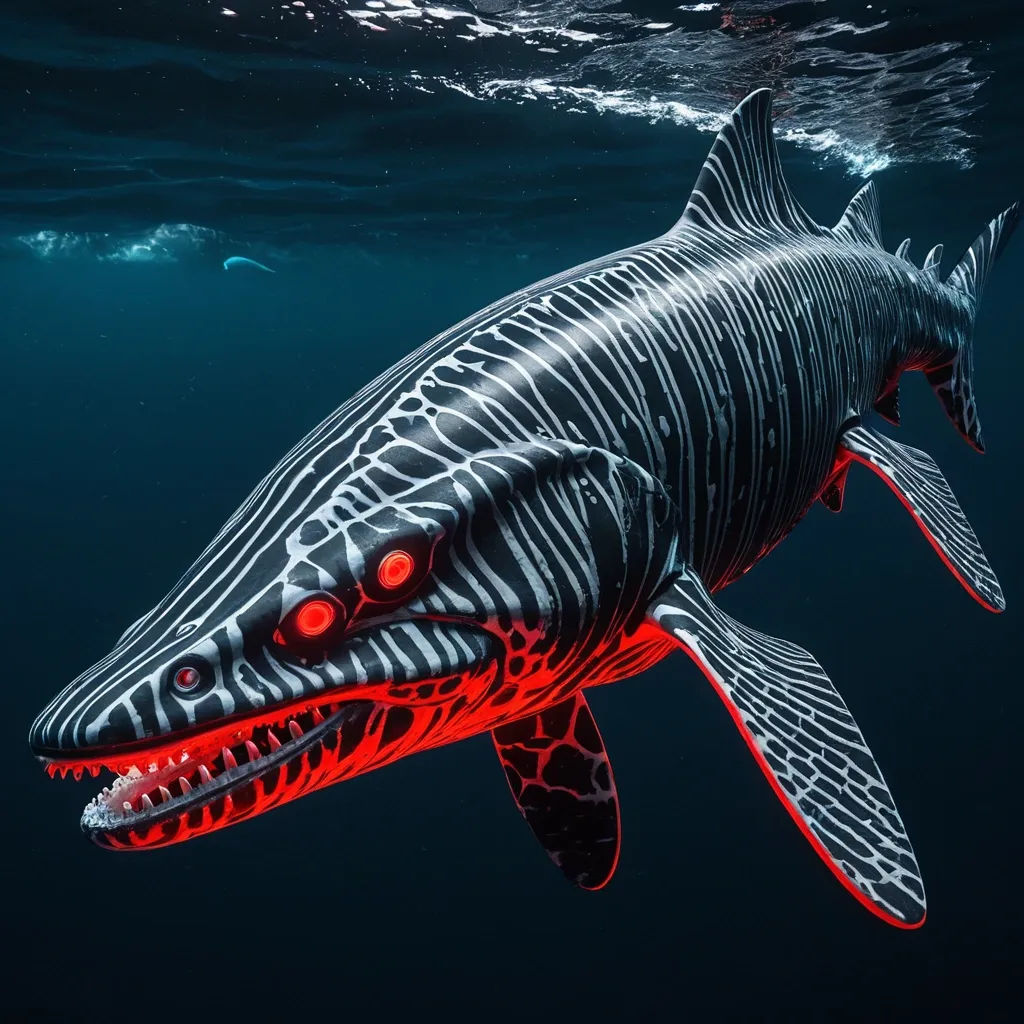
Megalosaurus Orca The Apex Hybrid of Oceanic Predation Physical Characteristics: Size & Weight: Between 40 to 60 feet in length , weighing 50 to 75 tons. Coloration: Males: Sleek black base with dark gray tiger stripes accented by subtle red bioluminescent highlights along the stripes , glowing faintly in deep ocean darkness. Females: Larger and more robust with black base and light gray tiger stripes , also featuring red bioluminescent patterns that pulse rhythmically. Body Structure: Hydrodynamic , muscular body combining the streamlined agility of the Shortfin Mako and Black Marlin with the robust power of Predator X and Megalodon. Rigid pectoral fins adapted from Black Marlin , capable of tilting back to reduce drag at high speeds. The tailend is a powerful fluke for propulsion , inspired by Mosasaurus Hoffmannii and Orca anatomy. Thick , overlapping bony scales similar to Arapaima , providing a durable armor that flexes with movement. Limbs: Powerful large flippers adapted for scooting or sliding on land , coated with mucus inspired by the Atlantic hagfish for moisture retention and defense. Capable of limited terrestrial movement , allowing brief excursions out of water. Head & Jaw: Massive jaws with over 40 , 000 PSI bite force , blending Predator X’s mighty jaw strength with the long canine teeth and powerful bite of the Leopard Seal. Flexible skull allowing swallowing of large prey whole. Respiration: Dual respiratory system with both functional lungs and gills , enabling survival from surface to abyssal depths (500 to 9 , 800 feet). Bioluminescence: Red bioluminescent photophores patterned in tiger stripes , used for communication , intimidation , mating displays , and luring prey in the dark ocean depths. Abilities & Traits: Speed & Agility: Capable of bursts up to 82 mph , rivaling the fastest sea creatures like the Black Marlin. Agile hunter using stealth and passive listening , mimicking Transient Killer Whale hunting strategies. Social Structure: Small family groups of three (one male , two females) designed for efficient reproduction and hunting. Males are more streamlined and shorter , optimized for speed and power; females are larger , robust , and agile for endurance and nurturing. Regeneration: Remarkable limb regeneration inspired by axolotl and Crown-of-Thorns starfish , able to regrow lost fins , limbs , and even parts of internal organs. Defense: Venomous spines derived from Crown-of-Thorns starfish line its dorsal ridge , delivering painful venomous wounds to attackers. Mucus coating for defense and moisture retention , also making it slippery and difficult to grasp. Healing: A blubber-like layer similar to dolphins provides insulation , buoyancy , and antimicrobial properties that accelerate healing of wounds. Communication: Uses low-frequency growls , barks , and hisses inspired by saltwater crocodile sounds , combined with bioluminescent signals and stealth vocalizations for hunting. Reproduction: Live births occur at extreme depths (up to 9 , 800 feet) , with offspring adapted to survive in crushing pressures and cold temperatures. ,
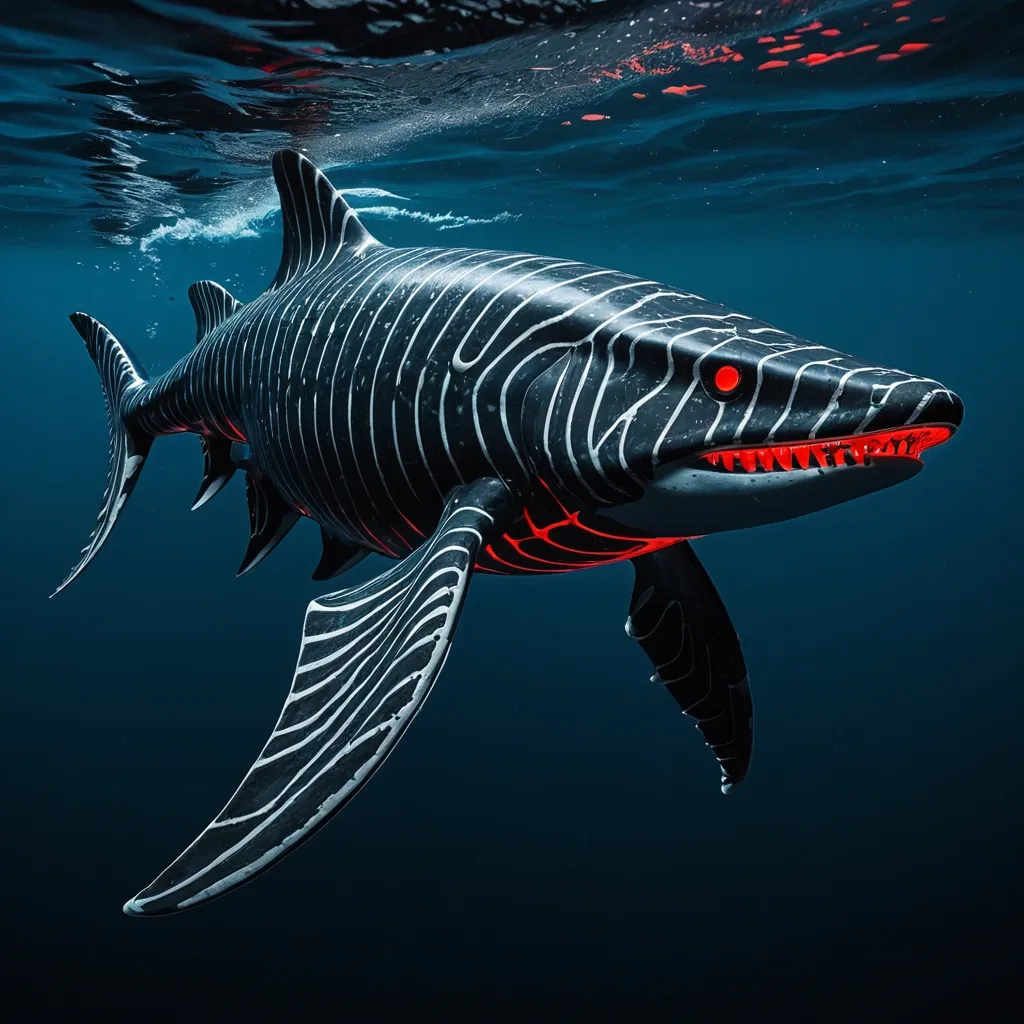
Megalosaurus Orca The Apex Hybrid of Oceanic Predation Physical Characteristics: Size & Weight: Between 40 to 60 feet in length , weighing 50 to 75 tons. Coloration: Males: Sleek black base with dark gray tiger stripes accented by subtle red bioluminescent highlights along the stripes , glowing faintly in deep ocean darkness. Females: Larger and more robust with black base and light gray tiger stripes , also featuring red bioluminescent patterns that pulse rhythmically. Body Structure: Hydrodynamic , muscular body combining the streamlined agility of the Shortfin Mako and Black Marlin with the robust power of Predator X and Megalodon. Rigid pectoral fins adapted from Black Marlin , capable of tilting back to reduce drag at high speeds. The tailend is a powerful fluke for propulsion , inspired by Mosasaurus Hoffmannii and Orca anatomy. Thick , overlapping bony scales similar to Arapaima , providing a durable armor that flexes with movement. Limbs: Powerful large flippers adapted for scooting or sliding on land , coated with mucus inspired by the Atlantic hagfish for moisture retention and defense. Capable of limited terrestrial movement , allowing brief excursions out of water. Head & Jaw: Massive jaws with over 40 , 000 PSI bite force , blending Predator X’s mighty jaw strength with the long canine teeth and powerful bite of the Leopard Seal. Flexible skull allowing swallowing of large prey whole. Respiration: Dual respiratory system with both functional lungs and gills , enabling survival from surface to abyssal depths (500 to 9 , 800 feet). Bioluminescence: Red bioluminescent photophores patterned in tiger stripes , used for communication , intimidation , mating displays , and luring prey in the dark ocean depths. Abilities & Traits: Speed & Agility: Capable of bursts up to 82 mph , rivaling the fastest sea creatures like the Black Marlin. Agile hunter using stealth and passive listening , mimicking Transient Killer Whale hunting strategies. Social Structure: Small family groups of three (one male , two females) designed for efficient reproduction and hunting. Males are more streamlined and shorter , optimized for speed and power; females are larger , robust , and agile for endurance and nurturing. Regeneration: Remarkable limb regeneration inspired by axolotl and Crown-of-Thorns starfish , able to regrow lost fins , limbs , and even parts of internal organs. Defense: Venomous spines derived from Crown-of-Thorns starfish line its dorsal ridge , delivering painful venomous wounds to attackers. Mucus coating for defense and moisture retention , also making it slippery and difficult to grasp. Healing: A blubber-like layer similar to dolphins provides insulation , buoyancy , and antimicrobial properties that accelerate healing of wounds. Communication: Uses low-frequency growls , barks , and hisses inspired by saltwater crocodile sounds , combined with bioluminescent signals and stealth vocalizations for hunting. Reproduction: Live births occur at extreme depths (up to 9 , 800 feet) , with offspring adapted to survive in crushing pressures and cold temperatures. ,